





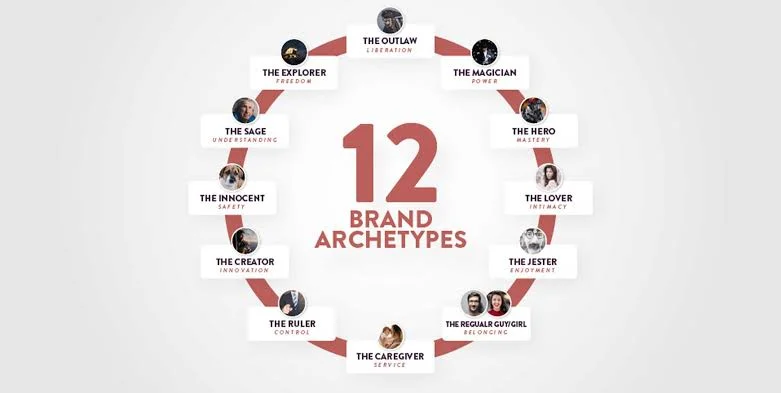
Brand archetypes are 12 universal personality types that brands use to shape how they look, sound and make people feel. The idea comes from psychologist Carl Jung, who said all humans share a set of familiar characters like the Hero, the Sage and the Rebel. In 2001, Margaret Mark and Carol Pearson turned these 12 archetypes into a branding framework in their book The Hero and the Outlaw. Today, big names like Nike (Hero), Apple (Creator), Dove (Innocent) and Harley-Davidson (Outlaw) use one clear marketing archetype to build trust and emotional connection. To pick yours, look at what your customers truly want, what your competitors are already doing and what your brand naturally stands for. Then commit to one main archetype and use it everywhere.
Quick answer: A brand archetype is a personality your brand acts out in every ad, post, logo and message. There are 12 archetypes: Innocent, Everyman, Hero, Outlaw, Explorer, Creator, Ruler, Magician, Lover, Caregiver, Jester and Sage. Choose one main archetype that matches your customer’s deepest desire, and add one supporting archetype if needed.
Key points at a glance:
- There are 12 brand archetypes, and each one is based on a core human desire like safety, freedom, belonging or success.
- The concept comes from Carl Jung’s work on the collective unconscious and was adapted for marketing in 2001.
- The 12 archetypes are grouped into four families: stability, belonging, mastery and independence.
- Famous archetypes with examples include Nike as the Hero, Google as the Sage, IKEA as the Everyman and Disney as the Magician.
- A good archetype matches your customer’s needs, stands apart from competitors and feels natural for your team.
- Most strong brands pick one primary archetype and, at most, one secondary archetype.
- A simple brand archetype quiz can help you find a starting point, but real research gives the final answer.
What Are Brand Archetypes?
A brand archetype is a familiar character that your brand plays in the minds of your customers. Think of it as your brand’s personality. It decides how you talk, what colours you use, what kind of photos you post and even how your support team replies to an email.
Have you ever defended a brand like it was a close friend? Maybe you argued for iPhone over Android, or felt a little upset when your favourite brand changed its logo. That feeling is not an accident. It happens because that brand has a clear personality, and you connect with it the way you connect with a person.
That is the real power of archetypes and brands working together. Instead of being a faceless company, your business becomes someone people recognise, remember and trust.
Where Do the 12 Archetypes Come From?
The idea started with Swiss psychiatrist Carl Jung. He believed that all humans share a collective unconscious, a set of stories, symbols and characters that show up in every culture. The brave hero, the wise old teacher and the rule-breaking rebel appear in myths, folk tales and movies all over the world. Jung called these patterns archetypes.
In 2001, Margaret Mark and Carol Pearson took this idea and applied it to marketing in their book The Hero and the Outlaw. Their main point was simple. Brands that stick to one archetype tap into a pattern that already exists in people’s minds. Because of that, those brands become easier to remember, easier to choose and harder to copy.
Why Brand Archetypes Matter in Marketing
People do not buy products only for features. They buy because a brand makes them feel something. A clear marketing archetype helps you create that feeling again and again.
Here is why it matters for your business:
- Consistency: Everyone on your team, from design to sales, knows how the brand should sound and look.
- Emotional connection: Customers feel like your brand understands them, which builds loyalty.
- Clear positioning: You stand out from competitors who are trying to be everything for everyone.
- Faster decisions: When a new campaign idea comes up, you can simply ask, “Does this fit our archetype?”
- Better content: Your blog posts, ads and social media captions all share one voice. This is something our content writing services focus on for every client.
Research backs this up too. According to a 2025 Ipsos survey cited by Shopify, around 70% of US adults say they tend to buy from brands that reflect their personal values. An archetype is one of the clearest ways to show those values.
The 12 Brand Archetypes at a Glance
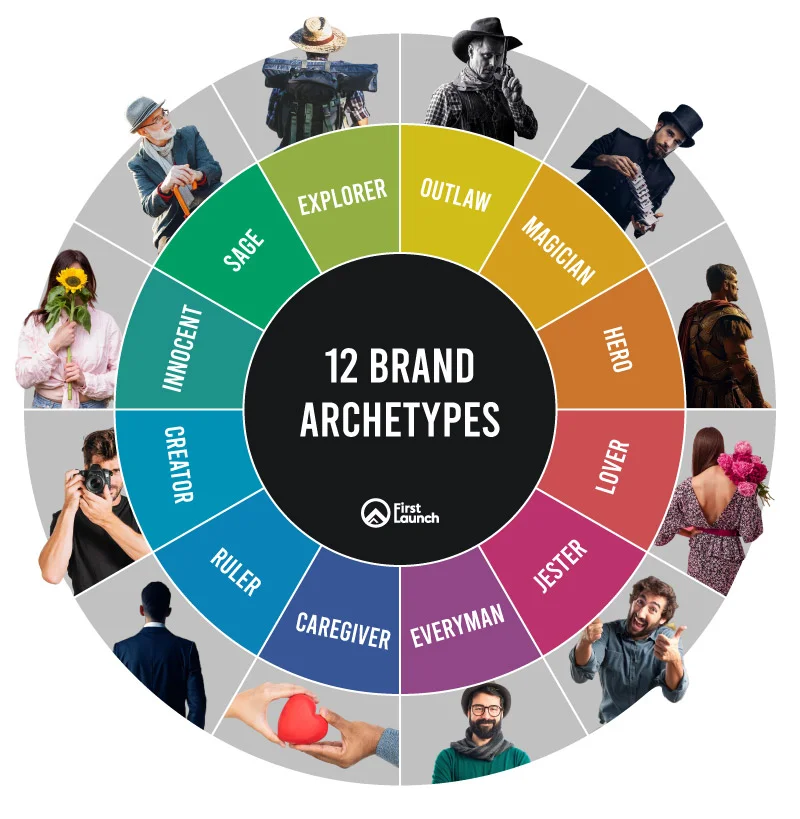
Before we go into each one, here is a quick table of all 12 archetypes with examples. Bookmark this as your cheat sheet.
| Archetype | Core Desire | Brand Voice | Famous Examples |
|---|---|---|---|
| The Innocent | To be happy and good | Warm, simple, honest | Dove, Coca-Cola, Aveeno |
| The Everyman | To belong and connect | Friendly, down to earth | IKEA, Home Depot, Ford |
| The Hero | To prove worth through courage | Bold, confident, inspiring | Nike, FedEx, Adidas |
| The Outlaw | To break the rules | Rebellious, raw, edgy | Harley-Davidson, Diesel, Virgin |
| The Explorer | To find freedom and discover | Adventurous, curious | The North Face, Jeep, Patagonia |
| The Creator | To build something lasting | Imaginative, expressive | Apple, LEGO, Crayola |
| The Ruler | To create order and lead | Refined, authoritative | Rolex, Mercedes-Benz, Microsoft |
| The Magician | To make dreams come true | Visionary, mysterious | Disney, Dyson, Tesla |
| The Lover | To create intimacy and pleasure | Sensual, passionate | Chanel, Godiva, Victoria’s Secret |
| The Caregiver | To protect and care for others | Nurturing, reassuring | Johnson & Johnson, UNICEF, Volvo |
| The Jester | To bring joy and fun | Playful, witty | Old Spice, M&M’s, Skittles |
| The Sage | To find and share the truth | Wise, analytical | Google, BBC, National Geographic |
The 4 Families of Brand Archetypes
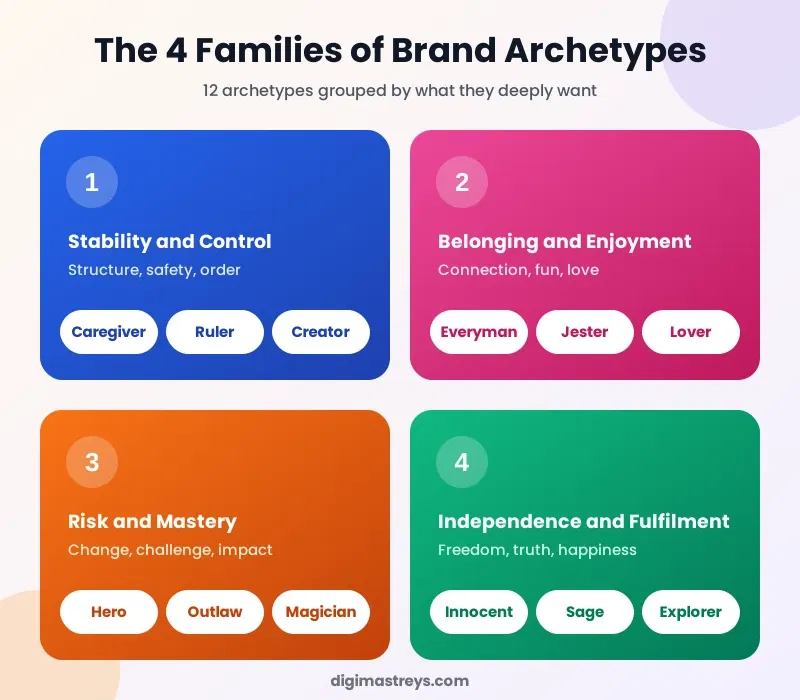
The 12 archetypes are grouped into four families based on what they deeply want. This makes it much easier to narrow down your choice.
| Family | Core Motivation | Archetypes Inside |
|---|---|---|
| Stability and Control | Structure, safety, order | Caregiver, Ruler, Creator |
| Belonging and Enjoyment | Connection, fun, love | Everyman, Jester, Lover |
| Risk and Mastery | Change, challenge, impact | Hero, Outlaw, Magician |
| Independence and Fulfilment | Freedom, truth, happiness | Innocent, Sage, Explorer |
The 12 Archetypes Explained With Examples
Now let’s look at each archetype in simple words. For every one, you will see what it wants, how it talks, where it can go wrong and which brands do it best.
1. The Innocent
The Innocent brand wants to make life feel simple, pure and happy. It is honest, optimistic and a little nostalgic. Innocent brands never try to scare or guilt-trip you. They make you feel safe and comfortable.
- Voice: Warm, sincere, cheerful
- Visual style: Soft pastels, lots of white space, gentle photos
- Watch out for: Looking naive or boring
- Examples: Dove, Coca-Cola, Aveeno
2. The Everyman (Regular Guy or Gal)
The Everyman is the friendly person next door. No fancy talk, no showing off. These brands are practical, reliable and made for everyday people.
- Voice: Plain, friendly, relatable
- Visual style: Real people, approachable colours
- Watch out for: Blending in too much and losing a unique identity
- Examples: IKEA, Home Depot, Ford, Target
3. The Hero
The Hero wants to prove its worth by being brave. These brands push you to overcome challenges and become your best self. If your product helps people perform at their peak, you may be a Hero.
- Voice: Bold, motivating, confident
- Visual style: Strong fonts, primary colours, action shots
- Watch out for: Sounding arrogant
- Examples: Nike (“Just Do It”), FedEx, Adidas
4. The Outlaw (The Rebel)
The Outlaw breaks rules and shakes up the industry. It speaks to people who are tired of the “normal” way of doing things. These brands are not afraid of a little controversy.
- Voice: Raw, rebellious, provocative
- Visual style: High contrast, black, rough textures
- Watch out for: Going too far and looking negative
- Examples: Harley-Davidson, Diesel, Virgin, Doc Martens
5. The Explorer
The Explorer wants freedom. It encourages people to step out, travel, try new things and discover who they really are. These brands love the outdoors and the unknown.
- Voice: Adventurous, independent, curious
- Visual style: Earth tones, landscape photography
- Watch out for: Not fitting into the mainstream
- Examples: The North Face (“Never Stop Exploring”), Jeep, Patagonia
6. The Creator
The Creator wants to build something meaningful that lasts. It inspires people to use their imagination and express themselves. These brands care deeply about design.
- Voice: Inventive, expressive, thoughtful
- Visual style: Clean layouts, custom fonts, plenty of space
- Watch out for: Being too perfectionist or impractical
- Examples: Apple, LEGO, Adobe, Crayola
7. The Ruler
The Ruler is all about control, leadership and quality. These brands feel premium and exclusive. When you buy from a Ruler, you feel like you are joining an elite club.
- Voice: Refined, commanding, polished
- Visual style: Gold and deep tones, serif fonts, symmetry
- Watch out for: Feeling cold or too controlling
- Examples: Rolex, Mercedes-Benz, Louis Vuitton, Microsoft
8. The Magician
The Magician turns ordinary moments into something special. It promises transformation and makes people say, “How did they do that?” These brands often use technology or wonder to amaze customers.
- Voice: Visionary, charismatic, slightly mysterious
- Visual style: Rich colours, dramatic lighting
- Watch out for: Over-promising
- Examples: Disney, Dyson, Tesla
9. The Lover
The Lover is about passion, beauty and closeness. These brands want customers to feel desired, special and appreciated. Their marketing is very visual and emotional.
- Voice: Sensual, warm, indulgent
- Visual style: Deep reds, rich textures, close-up shots
- Watch out for: Feeling shallow
- Examples: Chanel, Godiva, Häagen-Dazs, Victoria’s Secret
10. The Caregiver
The Caregiver exists to protect and help others. These brands make people feel safe and looked after. You often see this archetype in healthcare, education, family products and charities.
- Voice: Kind, nurturing, reassuring
- Visual style: Soft blues, rounded shapes, human photos
- Watch out for: Being taken for granted
- Examples: Johnson & Johnson, UNICEF, Volvo, TOMS
11. The Jester
The Jester just wants everyone to have a good time. These brands use humour to grab attention and make their content super shareable. They never take themselves too seriously.
- Voice: Funny, playful, cheeky
- Visual style: Bright colours, mascots, bold fonts
- Watch out for: Looking silly when the topic is serious
- Examples: Old Spice, M&M’s, Skittles, Dollar Shave Club
12. The Sage
The Sage is the trusted teacher. It wants to find the truth and share knowledge so people can make better decisions. These brands are calm, smart and backed by facts.
- Voice: Knowledgeable, measured, clear
- Visual style: Simple palette, data-led layouts
- Watch out for: Sounding preachy or too serious
- Examples: Google, BBC, The Economist, Harvard
How to Choose the Right Brand Archetype
Picking an archetype is not about choosing the one that sounds the coolest. It is about being honest with yourself about who your brand is and who your customers are. Follow these simple steps.
Step 1: Revisit Your Mission
Start with why your business exists. Ask yourself:
- What problem did I start this business to solve?
- What do I want customers to feel after using my product?
- Which causes or values matter most to my team?
If your software saves people time, are you giving them freedom (Explorer) or order (Ruler)? The answer points you in the right direction.
Step 2: Understand What Your Customer Really Wants
This is the most important filter. Look past the product and think about the deeper need it fills.
| If your customer wants… | Consider these archetypes |
|---|---|
| Safety and comfort | Caregiver, Innocent |
| Success and mastery | Hero, Sage |
| Status and prestige | Ruler, Creator |
| Belonging and connection | Everyman, Lover |
| Freedom and adventure | Explorer, Outlaw |
| Fun and joy | Jester |
| Transformation | Magician |
If the archetype does not match what customers truly want, they will feel the mismatch right away.
Step 3: Check Your Competitors
Look at your top five competitors and note which archetype each one is using. If every brand in your industry is a Hero, being a Sage or a Jester can make you stand out instantly. Copying the market leader’s archetype usually makes you look like a weaker version of them. A proper competitor review is also a core part of our SEO services, because it shows where the real gaps are.
Step 4: Match the Founder’s Natural Voice
Read how the founder writes and listen to how they talk. Over time, a brand naturally drifts toward the founder’s personality, no matter what the brand book says. Choose an archetype that fits that natural voice instead of fighting it.
Step 5: Pick One Primary and One Secondary Archetype
Humans are complex, but brands need clarity. Choose one main archetype as your anchor. If you want more depth, add one secondary archetype that works well with it. For example, SKIMS mixes the Lover (self-love campaigns) with the Creator (innovative product launches).
Brand Archetype Quiz: What Is My Archetype?
Many people search “what is my archetype” or look for an archetype quiz online. Here is a quick self-check you can do in two minutes. Answer each question honestly and note which archetype comes up the most.
Quick Brand Archetype Quiz
- When a customer finishes using your product, they should feel: (a) safe and cared for, (b) powerful and motivated, (c) amused and happy, (d) smarter and more informed
- Your brand would rather be: (a) trusted, (b) admired, (c) loved, (d) talked about
- Your ideal ad would show: (a) a family moment, (b) someone winning a tough challenge, (c) a funny twist, (d) someone discovering something new
- Your biggest fear as a brand is being seen as: (a) cold, (b) weak, (c) boring, (d) ordinary
How to Read Your Results
| Mostly… | Your likely archetypes |
|---|---|
| A answers | Caregiver, Innocent, Everyman |
| B answers | Hero, Ruler, Outlaw |
| C answers | Jester, Lover, Magician |
| D answers | Sage, Explorer, Creator |
This brand archetype quiz is a starting point, not a final answer. Once you have two or three options, read their full descriptions above and test them against your customers, competitors and mission.
How Your Archetype Shows Up in Real Marketing
An archetype only works when it shows up everywhere, not just in a slide deck. Here is where it should guide your decisions:
- Colours: A Sage uses calm, muted tones. A Jester uses bright, loud colours.
- Fonts: A Ruler likes elegant serif fonts. A Hero prefers bold, heavy fonts.
- Photos: A Caregiver shows warm human moments. An Outlaw shows raw street style.
- Copy and tone: Every caption, email and landing page should sound like the same character.
- Social media: A Jester posts memes, while a Sage shares tips and guides. Our social media marketing team builds content calendars around exactly this.
- Search and AI visibility: Consistent, helpful content in one voice also helps you show up in Google, AI Overviews and answer engines. You can learn more in our guide on GEO vs AIO vs SEO.
Common Brand Archetype Mistakes to Avoid
Even big brands get this wrong sometimes. Keep these mistakes in mind:
- Mixing opposite archetypes: Sage and Jester pull in very different directions. Hero and Outlaw work well together, but Sage and Outlaw usually clash.
- Choosing based on ego: Many founders want to be a Magician when their product is really an Everyman. Customers notice the gap.
- Drifting over time: A brand starts as a Creator and slowly becomes generic as more people add their opinions. Review your archetype once a year.
- Treating it as decoration: An archetype is a decision-making tool, not a tagline. If your product names, ads and support emails do not reflect it, it is not really being used.
- Trying to be everything: Brands that try to please everyone end up connecting with no one.
Final Thoughts
Brand archetypes give your business a face, a voice and a personality people can actually connect with. The 12 archetypes cover every major human desire, from safety and belonging to freedom and success. Your customers already recognise these characters, even if they have never heard the word “archetype.” The formula is simple. Understand your customer, study your competitors, stay true to your mission and pick one archetype to commit to. Then show it in every colour, word and campaign.
Knowing your archetype is the first step. Bringing it to life across your website, content, ads and social media is where most brands struggle, and that is exactly where Digimastreys can help. Our team turns your brand archetype into a clear voice and a content plan that connects with real people and ranks on Google, AI Overviews and answer engines. From SEO services and content writing to Google Ads management, we make sure every touchpoint sounds like the same brand.
Not sure which archetype fits your business? we will help you find it and use it to grow. You can also explore more practical marketing guides on the Digimastreys blog.
Frequently Asked Questions About Brand Archetypes
What are the 12 brand archetypes?
The 12 brand archetypes are the Innocent, Everyman, Hero, Outlaw, Explorer, Creator, Ruler, Magician, Lover, Caregiver, Jester and Sage. Each one represents a core human desire and gives a brand a clear personality.
Who created the brand archetypes?
Carl Jung first described archetypes as universal characters shared by all humans. Margaret Mark and Carol Pearson later turned them into the 12 brand archetypes in their 2001 book The Hero and the Outlaw.
What is a marketing archetype?
A marketing archetype is the personality a brand uses across its marketing. It guides the tone of ads, website copy, social posts, visuals and customer service so everything feels like it comes from one character.
How do I find out what my archetype is?
Start with a simple archetype quiz like the one above. Then check three things: what your customers deeply want, which archetypes your competitors already use and what feels natural for your founder and team. The archetype that fits all three is your best choice.
Is there a free brand archetype quiz?
Yes, many websites offer a free brand archetype quiz. They are a good starting point, but they only give you a general direction. Real customer research and competitor analysis will give you a more accurate answer.
Can a brand have more than one archetype?
Yes. Most brands have one primary archetype and one secondary archetype. The primary one leads, and the secondary one adds depth. Just avoid mixing two opposite archetypes.
Can a brand change its archetype?
Yes, through a rebrand. Old Spice is a well-known example. It moved from a traditional, safe image to a funny Jester personality, and the change brought the brand back to life with younger buyers.
What is the difference between a brand archetype and a brand persona?
A brand archetype is one of the 12 fixed personality types. A brand persona is broader and more detailed. You can have both. For example, your archetype could be the Magician, while your persona is a friendly, creative guide named after your founder.
Which brand archetype is best for small businesses?
There is no single best archetype. Local service businesses often do well as the Everyman or Caregiver because trust matters most. Tech startups often lean toward the Creator, Magician or Sage. The best one is the one that matches your customers and feels honest.
How are brand archetypes different from brand personality types?
Brand archetypes are based on Jung’s 12 characters. Brand personality types, created by Stanford professor Jennifer Aaker, use five broad traits: sincerity, excitement, competence, sophistication and ruggedness. Both can be used together.

Vikas Verma is an SEO specialist and web designer focused on SEO strategy, website design, and digital experiences.