








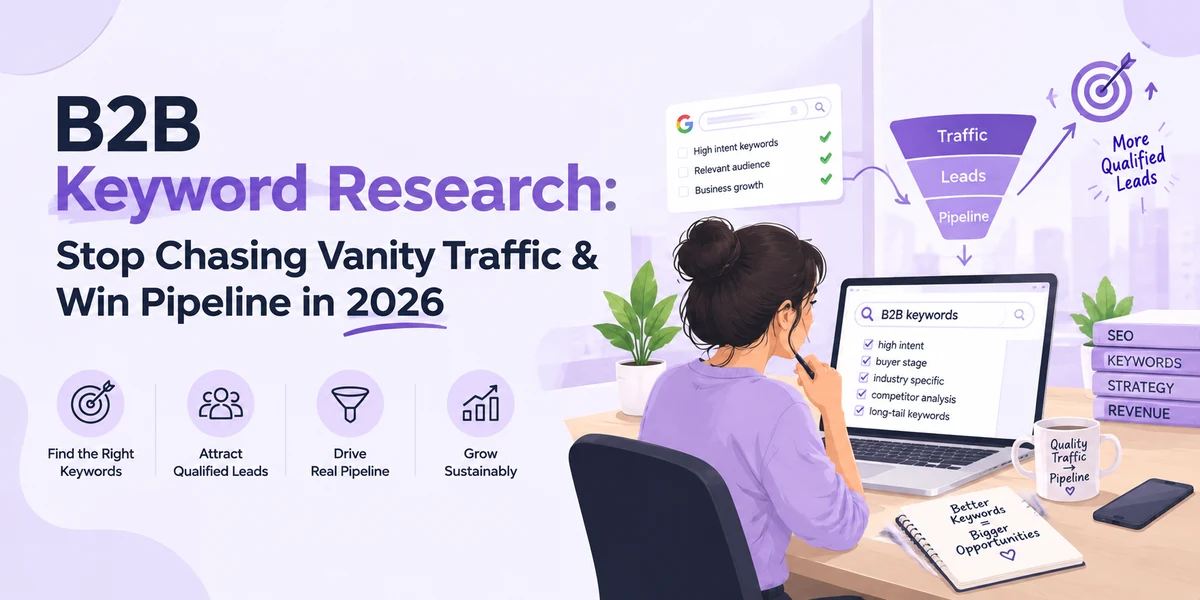
Traditional B2B keyword research is broken. For over a decade, the playbook has remained identical: log into tools like Ahrefs or Semrush, type in a broad category name, filter by high search volume, and assign writers to churn out generic pillar posts targeting head terms. The inevitable result? Hundreds of competitors fighting tooth and nail over generic terms like “CRM software” or “cybersecurity platform,” while the actual enterprise buyers who sign six-figure contracts use an entirely different vocabulary.
Two tectonic shifts have rendered volume-driven SEO obsolete:
-
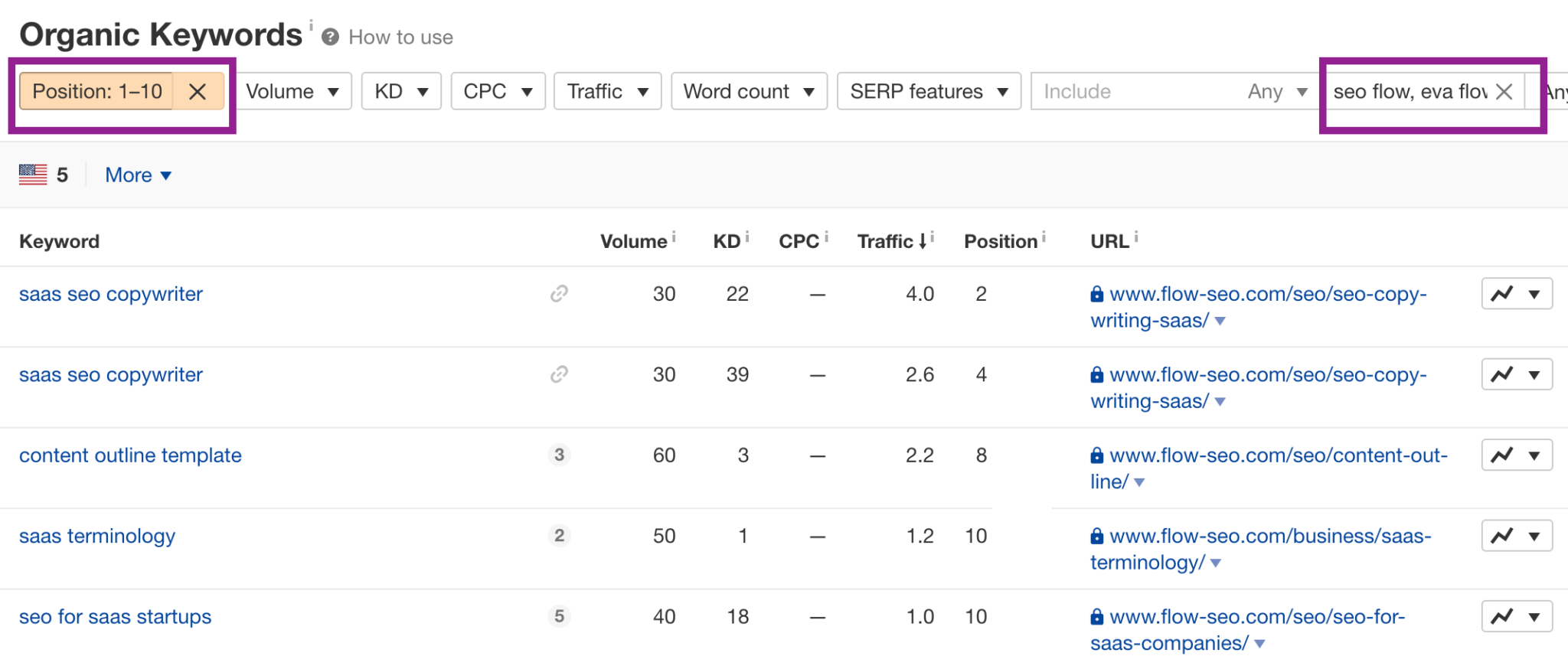
The Death of Volume-Driven ROI: B2B markets are inherently narrow. The exact search terms that bring in qualified pipeline often show monthly search volumes between 0 and 50 in traditional SEO tools.
-
The Rise of Conversational AI Search: Modern procurement committees and decision-makers conduct deep research across ChatGPT, Perplexity, Gemini, and Google AI Overviews. They don’t type two-word fragments; they input granular, multi-turn prompts complete with corporate constraints, budget thresholds, and regulatory needs.
This comprehensive guide breaks down how to execute advanced B2B keyword research tailored for the generative search era, aligning your content architecture with Voice of Customer (VoC) data and Generative Engine Optimization (GEO) to dominate pipeline generation.
Why Legacy B2B Keyword Research Fails Today
In B2C sectors, high search volume equals high revenue potential because consumer bases are massive and conversion cycles are short. B2B dynamics are fundamentally different:
-
Niche Total Addressable Markets (TAM): Your ideal customer profile (ICP) might consist of only 2,500 target accounts worldwide. A keyword showing 15,000 monthly searches is almost entirely driven by curious students, casual browsers, and junior researchers.
-
Multi-Stakeholder Buying Committees: A single B2B software purchase involves users, engineering leads, security officers, procurement specialists, and financial approvers each searching for completely different problem statements.
-
Extended Sales Cycles: Enterprise buyers research solutions over months, shifting from initial problem awareness to rigorous vendor validation.
-
The High Yield of a Single Conversion: Securing just one qualified demo or closed-won enterprise contract per month from a hyper-targeted long-tail keyword page is infinitely more valuable than 20,000 top-of-funnel visits from unqualified traffic.
Relying solely on keyword volume data produces three critical business traps:
-
Unwinnable Competition: Pitting a mid-market brand against legacy market leaders for high-volume head terms wastes precious marketing budget.
-
Intent Mismatch: Informational head terms attract researchers rather than active buyers evaluating vendors for immediate purchase.
-
Commoditized Content Echoes: When every competitor targets the same seed keywords, articles become near-identical rewrites. In an era where AI search engines synthesize answers instantly, LLMs simply summarize these generic pages without sending a single click to your domain.
How Generative AI Search Redefines Keyword Discovery
As search behavior shifts toward conversational platforms, keyword research must expand from static strings into intent mapping and prompt engineering.
-
Keywords Have Evolved Into Complex Prompts: Instead of typing
“employee monitoring software”, a Chief Operating Officer types: “We are a 200-person hybrid company based in Frankfurt. What tools allow productivity tracking without violating strict GDPR mandates or damaging team trust?” These prompts pack dense layers of context: company size, geographic constraints, regulatory frameworks, and emotional concerns. -
Conversations Are Multi-Turn: Initial queries naturally flow into follow-up prompts such as “Which of these options integrate with Workday?”, “How do their enterprise pricing tiers scale?”, and “What are the deployment security risks?” Vendors cited in these secondary and tertiary responses are the ones shortlisted by the buyer.
-
Definitional Clicks Are Shrinking: Because generative engines answer basic definitional questions directly within the summary interface, your content strategy must focus on un-automatable insights: first-hand executive experience, proprietary benchmarks, and detailed workflow use cases.
Sourcing High-Intent B2B Keywords From Voice of Customer (VoC) Data
Traditional SEO tools provide aggregated metrics stripped of operational context. To uncover true commercial intent, your keyword strategy must originate inside your sales discovery calls, customer success feedback loops, and support ticket archives.
Voice of Customer (VoC) data uncovers:
-
Exact pain points expressed in the buyer’s natural professional vocabulary.
-
Specific operational bottlenecks, tech-stack dependencies, and compliance barriers.
-
Competitive objections and evaluation criteria.
-
The exact trigger event that forced them to seek an urgent solution.
Primary VoC Channels for B2B Keyword Mining
| Source | What You Uncover | How to Collect It |
| Sales Discovery Calls | Triggers, real-world operational friction, evaluation hurdles | Transcripts via Gong, Chorus, Fireflies, or Day.ai |
| Objection & Lost-Deal Calls | Hesitations, pricing pushback, competitor roadblocks | Ask account executives to flag specific objection clips in your CRM |
| Customer Support Tickets | Implementation roadblocks, technical “How do I…” queries | Helpdesk exports (Zendesk, Intercom), onboarding notes |
| Community & Peer Discussions | Unfiltered professional complaints and product preferences | Reddit communities, specialized Slack/Discord groups, LinkedIn discussions |
A 7-Step Framework for Modern B2B Keyword Research
Step 1: Define Your ICP and Buying Committee
Map out every persona involved in a purchase decision for your solution: the end user, the technical evaluator, the financial approver, and the final executive decision-maker. Each role speaks a distinct professional language and searches for entirely different phrases.
Step 2: Extract Conversational Data
Pull 25 to 30 recent sales discovery call transcripts or CRM notes. Focus heavily on moments where prospects articulate their frustrations with legacy tools or outline complex compliance requirements.
Step 3: Build a Structured Pain Point Library
Scan transcripts for qualitative triggers like “We struggle with…”, “The main bottleneck is…”, or “How do we handle…”. Log these in a master tracker capturing the exact quote, department role, frequency, and buying stage. You can accelerate this analysis using tools like Claude or NotebookLM, but always verify exact phrasing manually to avoid AI smoothing out valuable buyer jargon.
Step 4: Translate Pain Points Into Search Keywords & Prompts
Convert raw buyer problems into dual-purpose search assets: traditional search queries for SEO tools and long-form prompts for AI research engines.
| Buyer’s Real Voice | Target SEO Keyword | AI Search Prompt |
| “Our engineers hate clunky ticketing systems that slow down deployment.” | developer-friendly IT service desk | What is the best IT service desk software for engineering teams that integrates natively with GitHub and Jira? |
| “We keep failing SOC 2 compliance audits because our cloud permissions are messy.” | automated cloud compliance tool for SOC 2 | How can a 50-person SaaS startup automate cloud security posture management to pass SOC 2 Type II quickly? |
Step 5: Prioritize Bottom-of-Funnel (BOFU) Keywords
Focus heavily on high-intent conversion terms rather than broad informational volume. Proven BOFU patterns include:
-
[Category] for [Industry/Role](e.g., Billing automation for healthcare providers) -
[Competitor] Alternative(e.g., Stripe Billing alternative for enterprise scale) -
[Product A] vs [Product B](e.g., HubSpot vs Salesforce migration guide) -
[Category] Pricing & Cost(e.g., Enterprise cloud migration pricing models)
Step 6: Audit Competitor Visibility & AI Search Citations
Analyze your top competitors in Ahrefs or Semrush to locate ranking gaps and content omissions. Next, test your priority AI prompts inside ChatGPT, Perplexity, and Gemini to identify which brand websites are consistently cited as primary authorities. For deeper tactical alignment, review strategies outlined in our guide on Generative Engine Optimization (GEO).
Step 7: Audit and Refresh Existing Content
Before drafting new pages, audit existing assets for declining traffic due to AI answer summaries, missing subject-matter-expert (SME) depth, or keyword cannibalization. Refreshing underperforming pages with proprietary data yields faster authority gains than publishing unverified new posts. Learn more about optimizing content structures in AI Content on-page SEO.
Crafting B2B Content That Ranks in Search and Gets Cited by AI
Finding the right keyword is only half the battle. To earn visibility in both Google and generative engines, your content must exhibit un-fakeable authority signals:
-
First-Hand Experience & Subject Matter Experts: Incorporate real quotes, insights, and case studies from internal practitioners (“Our engineering team faced this exact migration challenge…”).
-
Proprietary Data and Benchmarks: Publish anonymized benchmarks, internal case studies, or original research that cannot be scraped from generic web articles.
-
Comprehensive Follow-Up Coverage: Anticipate and answer the next three questions a buyer will ask regarding implementation timelines, total cost of ownership (TCO), and security risks.
-
Clear Attribution & Citations: Structure content cleanly with H2/H3 hierarchies, schema markup, and transparent referencing to maximize parseability for web crawlers.
To ensure your technical architecture supports conversational discovery, consult our guide on how to Optimize Website for ChatGPT and Perplexity AI Search.
Measuring B2B Keyword Success
Move beyond vanity metrics and measure what impacts revenue:
-
Pipeline Contribution & Conversions: Track demo requests, trial activations, and qualified sales-assisted pipeline generated per page.
-
LLM Citation Frequency: Monitor how often your brand and specific documentation URLs are cited when running target prompts in AI assistants.
-
AI Referral Traffic: Monitor specialized GA4 custom channels for traffic originating from
chatgpt.com,perplexity.ai, and related generative platforms. -
Self-Reported Attribution: Add a mandatory free-text “How did you hear about us?” field on your conversion forms to capture dark social and AI-driven word-of-mouth discoveries.
Frequently Asked Questions (FAQ)
What are B2B keywords?
B2B keywords are search queries, phrases, and conversational prompts used by professional buyers, managers, and enterprise decision-makers when researching business solutions, software categories, or specific vendor options.
How is B2B keyword research different from B2C?
B2C keyword research relies heavily on high search volume because markets are broad and buying cycles are short. B2B markets are specialized, involve multi-person purchasing committees, and feature high-value transactions making qualitative user intent and Voice of Customer data vastly more important than raw traffic numbers.
How do you find B2B marketing keywords with low search volume?
Instead of relying solely on keyword volume tools, mine sales discovery call transcripts, customer success onboarding notes, and support tickets for recurring phrasing. Treat the frequency of a problem in customer conversations as your true demand signal.
Do traditional SEO keywords still matter in the age of AI search?
Yes. Traditional keywords act as topic anchors and core pillars. However, modern keyword research must expand to include conversational prompts, long-tail questions, and multi-turn query intent to capture visibility across generative AI engines.

SURBHI THAPA
Surbhi Thapa is an SEO specialist focused on SEO strategy and content optimization.
Surbhi Thapa is an SEO specialist focused on SEO strategy and content optimization.