







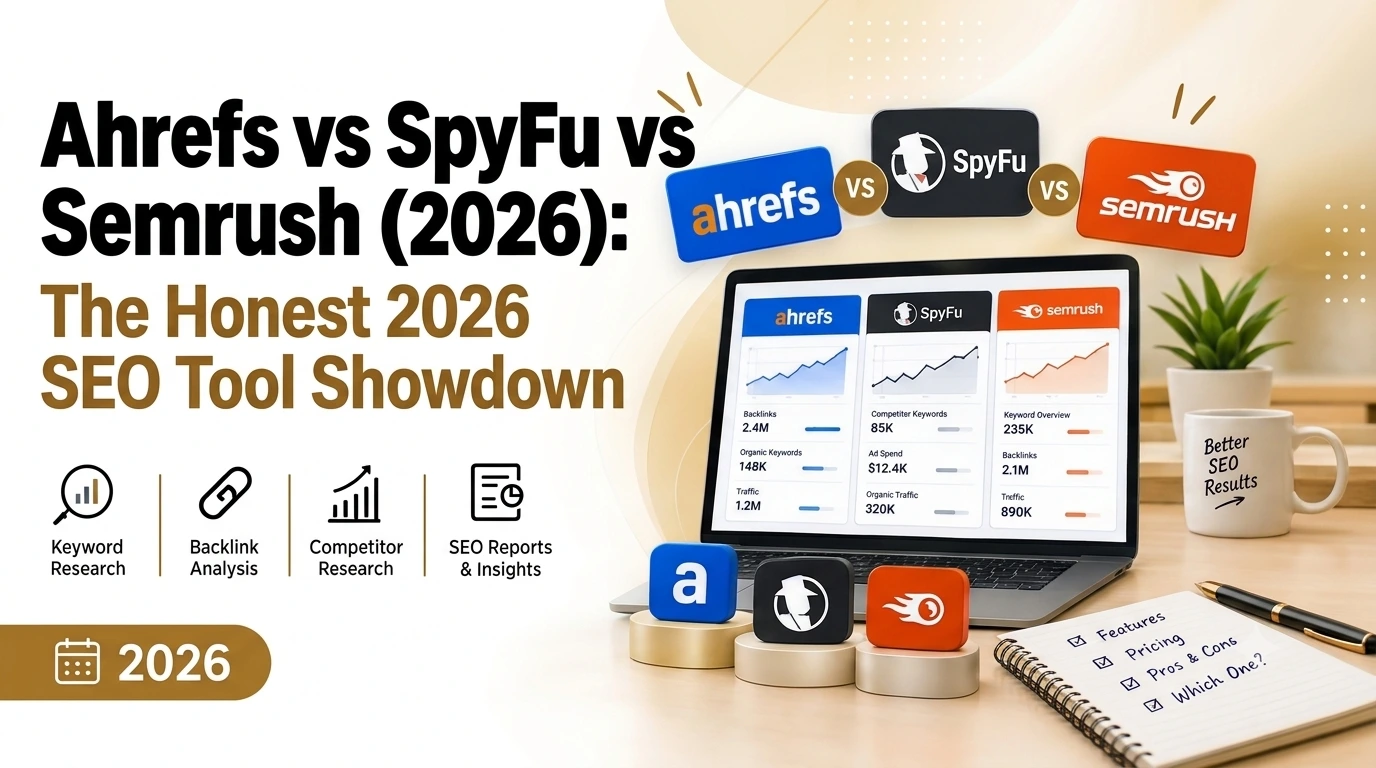
Opening your browser to pick an SEO platform often leads straight into a wall of aggressive marketing promises. Paying hundreds of dollars every month for tools you might never open is a real fear. When comparing Ahrefs vs SpyFu vs Semrush, you face three distinct platforms with drastically different price tags, seat restrictions, and primary workflows.
To help you invest without regret, we verified all feature tiers, limits, and pricing structures directly from official sources in October 2026.
By the end of this breakdown, you will know:
- Which platform directly aligns with your core organic or paid growth goals.
- What you will actually pay each month after factoring in true plan limits and extra seats.
- Which tool provides real, actionable data for tracking brand visibility across AI search engines.
Ahrefs vs SpyFu vs Semrush: The Short Answer
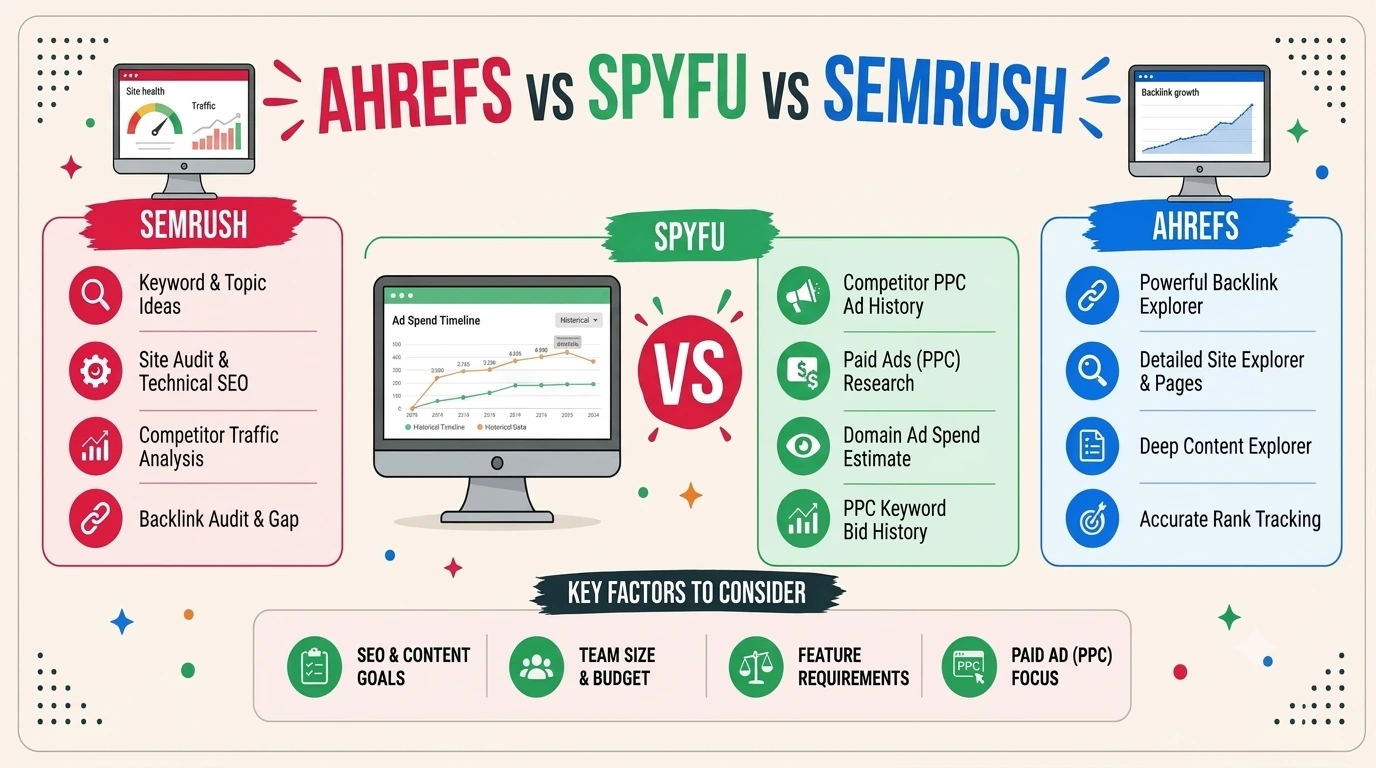
Ahrefs, SpyFu, and Semrush target vastly different core workflows, feature limits, and price points. Verified in October 2026, Ahrefs focuses heavily on backlink analysis and precise organic search metrics, while Semrush acts as a comprehensive marketing suite equipped with local SEO and AI search tracking. SpyFu delivers a budget-friendly option centered on competitor advertising and historical Google Ads data. Your choice depends on whether you prioritize link profiles, multi-channel marketing, or low-cost PPC research.
Keypoints:
- Best overall tool: Semrush provides the broadest marketing functionality, covering technical audits, keyword research, local listings, and AI visibility.
- Best for backlinks: Ahrefs features the cleanest, most reliable backlink crawler and data accuracy for digital PR.
- Best for PPC: SpyFu offers extensive historical Google Ads data to analyze competitor ad copy and strategy.
- Best budget pick: SpyFu offers the lowest entry price at $39 per month for unlimited competitive search research.
- Best for local SEO: Semrush features dedicated listing management, review tracking, and ZIP-code level rank monitoring.
- Best for AI search tracking: Semrush tracks brand citations and prompt visibility across ChatGPT, Gemini, and Perplexity natively.
- Biggest buyer mistake: Buying a high-tier subscription without accounting for additional seat fees, add-ons, or usage credits.
How We Compared These Tools
Choosing the right SEO software comes down to how well a tool handles daily, real-world execution across your core channels. To evaluate Ahrefs, SpyFu, and Semrush fairly, we analyzed each platform across six key performance criteria:
- Keyword Research & Database Scale: Keyword volume accuracy, intent mapping, difficulty scoring models, and database depth.
- Backlink Analysis: Index size, crawler freshness, toxic link detection, and link-building outreach workflows.
- Competitor & PPC Intelligence: Ad copy history, paid keyword footprints, budget estimates, and competitive gap analysis.
- Site Audit & Technical SEO: Crawling depth, Core Web Vitals tracking, schema validation, and prioritize-and-fix accuracy.
- Local SEO & AI Search Tracking: Local citation monitoring, ZIP-code rank tracking, and prompt visibility across generative search engines (ChatGPT, Gemini, Perplexity).
- Pricing & True Cost: Base plan limits, seat costs, add-on pricing, and usage credits.
All pricing, limits, and feature plans were verified directly against official pricing pages in October 2026. Any specific database size numbers or keyword totals claimed directly by tool makers are explicitly labeled “vendor-claimed” to prevent bias.
Ahrefs vs SpyFu vs Semrush at a Glance
Comparing core capabilities across all three platforms helps you spot immediate strengths and key limitations before buying.
| Feature | Ahrefs | Semrush | SpyFu |
| Best for | Organic SEO, backlinks, digital PR | All-in-one marketing, local SEO | PPC research, budget competitor tracking |
| Strongest feature | Accurate backlink index & Site Explorer | Keyword Magic Tool & 130+ technical checks | Years of Google Ads history & Kombat tool |
| Weakest area | Secondary PPC data & no native local SEO | Tool volume steep learning curve | No real site audit & smaller link index |
| Site audit | Comprehensive technical & internal link checks | Advanced checks (130+ technical & Core Web Vitals) | Not available (no crawl-based site audit) |
| Backlink data | Industry-leading freshness & accuracy (~35T links) | Massive raw index (~43T links) | Limited (~1T links) for basic checks |
| PPC & ad history | Basic paid keyword estimates | Strong ad research & copy history | Unmatched historical Google Ads data |
| Local SEO | Basic GBP tracking (Beta) | Dedicated local toolkit & ZIP rank tracking | No native local SEO tools |
| AI search visibility | Brand Radar AI (mentions & prompt checks) | Native AI search & prompt research tracking | SpyGPT (basic brand mention checks) |
| Entry price (monthly) | $29 (Starter) / $129 (Lite) | $139.95 (Pro) / $117.33 annual | $39 (Basic) |
| Learning curve | Moderate | Steep | Low (most beginner-friendly) |
Use this high-level table to eliminate tools that lack your required features right away. For example, choose Semrush or Ahrefs if technical site audits are essential, as SpyFu does not offer website crawling.
Ahrefs, Semrush and SpyFu Explained
Ahrefs: Best for Backlinks and Organic Research
Buy Ahrefs if your SEO growth heavily relies on link building, digital PR, and precise organic keyword research. It provides the cleanest link index and backlink-based difficulty scores to help you target terms you can actually rank for.
Where Ahrefs wins
- Superior link database: Offers real-time backlink discovery and accurate Domain Rating metrics.
- Realistic difficulty metrics: Calculates keyword difficulty strictly using referring domains rather than domain-level authority.
- Actionable content gaps: Quickly identifies low-competition topics and do backlinks still matter opportunities using Site Explorer.
Where Ahrefs falls short
- Restricted entry plan: The $29 Starter plan is very restricted, offering just 1 project and 200 monthly credits.
- Secondary PPC tools: Delivers basic paid search visibility compared to dedicated ad-tracking competitors.
- No local SEO management: Lacks native tools for managing local business citations and reviews.
Starting at $29/month for Starter and $129/month for Lite, costs rise quickly as team usage scales. You can compare plans on the official Ahrefs pricing page.
Semrush: Best All-in-One Platform
Choose Semrush if you manage multi-channel digital marketing campaigns that combine organic SEO, PPC, content strategy, and local listings under one dashboard. It provides the broadest toolkit for growing agencies and in-house teams.
Where Semrush wins
- Keyword Magic Tool: Access 25B+ keywords with intent labels and generative engine optimization guide support.
- Advanced site audits: Runs 130+ technical health checks and tracks Core Web Vitals to execute a technical SEO checklist 2026.
- Dedicated local toolkit: Manages directory listings, local reviews, and local SEO and AI search strategy 2026 across specific ZIP codes.
Where Semrush falls short
- Steep learning curve: Navigating over 50+ specialized marketing tools can easily confuse beginner users.
- Restrictive base tracking: The entry Pro plan limits rank tracking to only 500 keywords per month.
- Costly team expansion: Adding extra user seats and optional modules significantly raises monthly bills.
Entry-level pricing starts at 139.95/monthfortheProplan(117.33/month billed annually). You can verify all current tiers directly on the Semrush pricing page.
SpyFu: Best Budget Tool for Competitor and PPC Research
Buy SpyFu if your primary focus is Google Ads, budget-friendly competitor tracking, and uncovering historical PPC strategy. It provides extensive ad history at a fraction of the cost of all-in-one SEO platforms.
Where SpyFu wins
- Deep PPC ad history: Uncovers years of competitor Google Ads copy, estimated spend, and profitable target keywords.
- Kombat comparison tool: Visualizes keyword overlaps between multiple domain competitors across organic and paid search.
- Affordable entry point: Offers generous data exports without imposing aggressive per-click usage limits.
Where SpyFu falls short
- No technical site audit: Lacks website crawling tools to evaluate schema, Core Web Vitals, or indexing errors.
- Smaller backlink database: Offers limited backlink coverage compared to the massive indexes of Ahrefs or Semrush.
- No local SEO tools: Does not support local directory management, GBP tracking, or review monitoring.
Starting at $39/month for the Basic plan, higher tiers add team seats and API access (check the official SpyFu pricing page to verify higher plans). Note that SpyFu’s ~73 billion keyword database total is vendor-claimed, so test search volumes with your own domains first.
H2: Head-to-Head: Which Tool Wins for Each Job?
Keyword Research: Which Tool Gives You Better Data?
Winner: Depends on your core goal
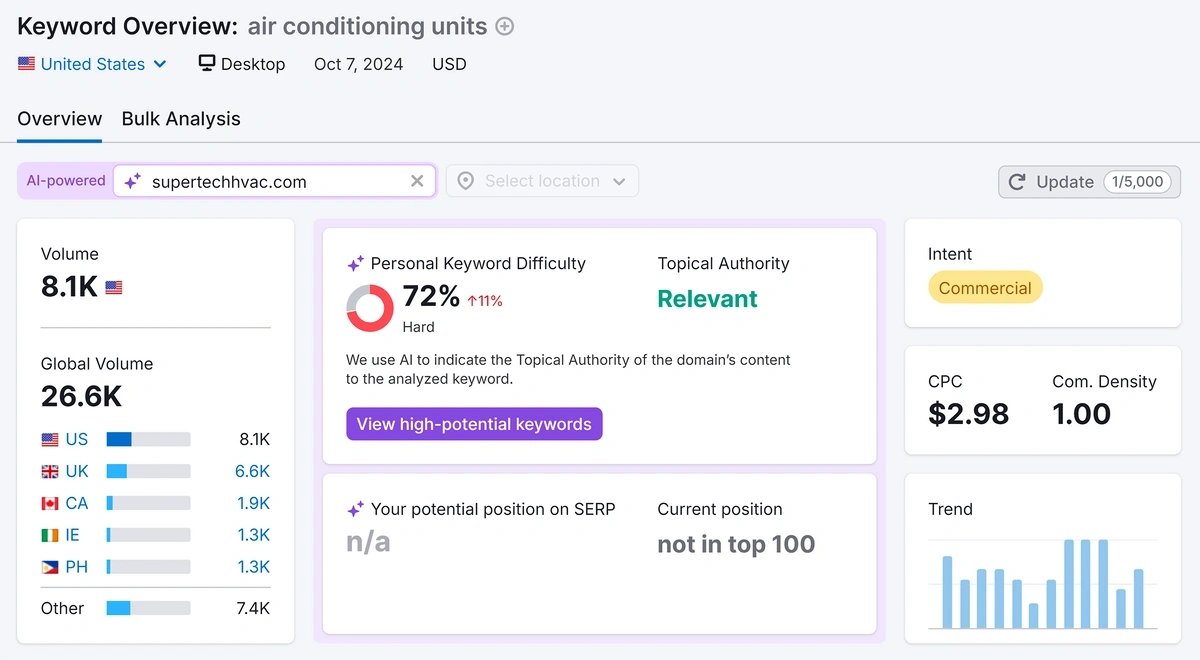
Ahrefs, Semrush, and SpyFu process search data using entirely different models. Ahrefs calculates keyword difficulty strictly based on referring domains, giving you a clear view of link-building demands. Semrush provides explicit intent labels (Informational, Navigational, Commercial, Transactional) alongside personalized difficulty metrics. SpyFu shines when reverse-engineering competitor domain portfolios to uncover high-ROI paid and organic targets. Read our Ahrefs vs Semrush quick comparison for a deeper feature breakdown.
Search volume estimates also vary widely across platforms. For example, testing the query “best SEO software” yields 4,100 monthly searches in Ahrefs, 1,300 in Semrush, and 320–480 in SpyFu. Always treat search volume as an estimated range rather than an exact figure.
Backlink Analysis: Who Has the Better Link Data?
Winner: Ahrefs
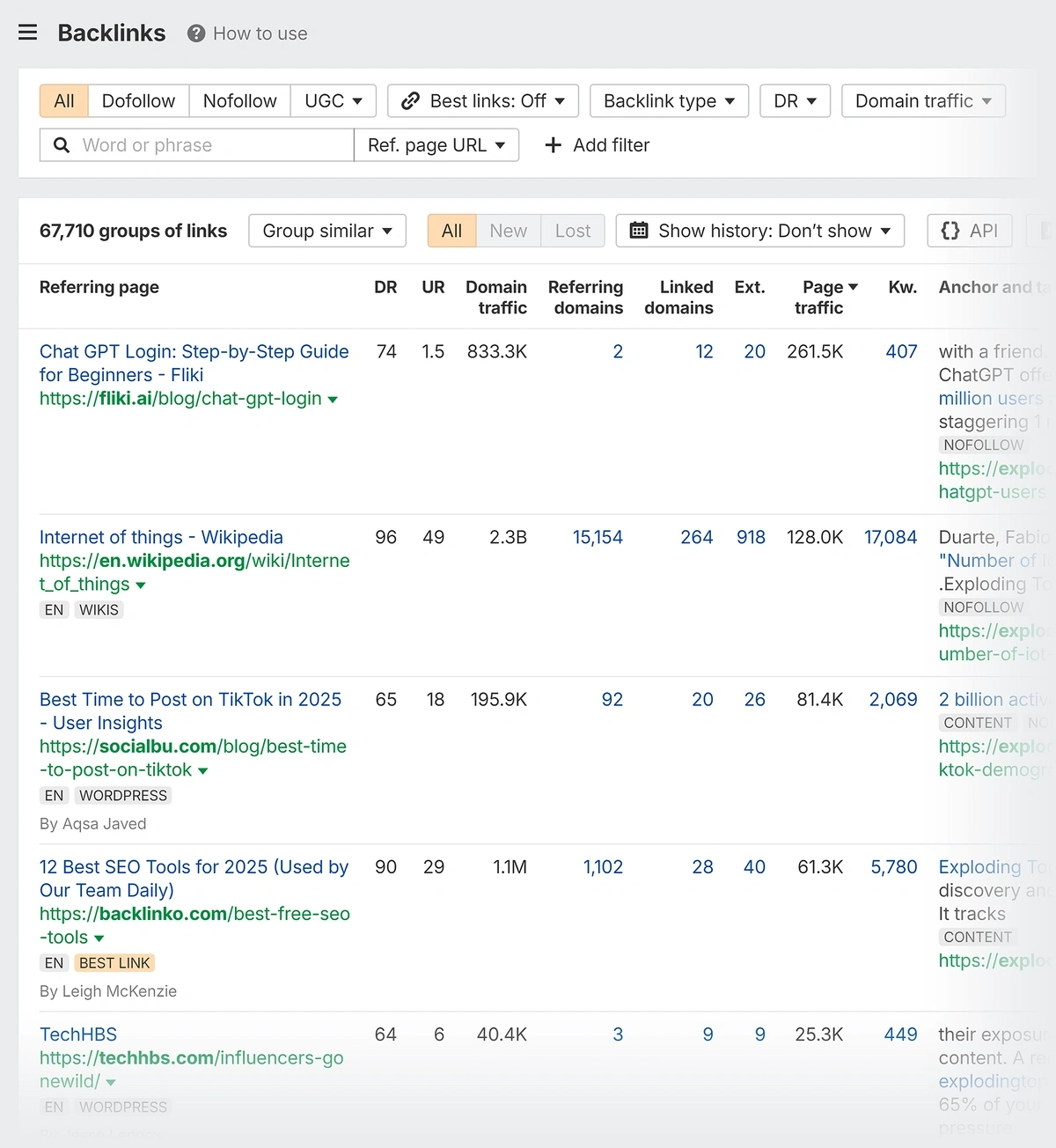
Ahrefs remains the gold standard for link intelligence due to its unmatched crawler speed and clean data quality. Its 35-trillion-link index recrawls constantly, giving you a reliable view of new, lost, and broken links while evaluating whether do backlinks still matter for your target terms.
Semrush holds a massive 43-trillion-link index and excels at workflow integration through its automated Backlink Audit and outreach tools. SpyFu provides a smaller index of around 1 trillion links, suitable for quick competitor checks but insufficient for deep link profiling.
Link Builder Tip: Use Ahrefs Link Intersect to find sites linking to two or more competitors, then filter by Domain Rating to target high-authority opportunities.
Competitor and PPC Research: Who Shows You What Rivals Are Doing?
Winner: SpyFu
SpyFu leads competitor intelligence by specializing in historical Google Ads data and ad copy archives. Its Kombat tool instantly reveals keyword gaps across rivals, showing which terms competitors repeatedly buy and which ad variations they run longest. Semrush places a strong second with deep traffic analytics and paid search data, whereas Ahrefs treats paid search visibility purely as a secondary metric.
Budget-Saving Tip: Filter competitor ad history in SpyFu to find copy variations that ran continuously for six months or longer. Mirroring tested ad messaging saves you from spending ad budget on failed messaging experiments.
Site Audit and Technical SEO
Winner: Semrush
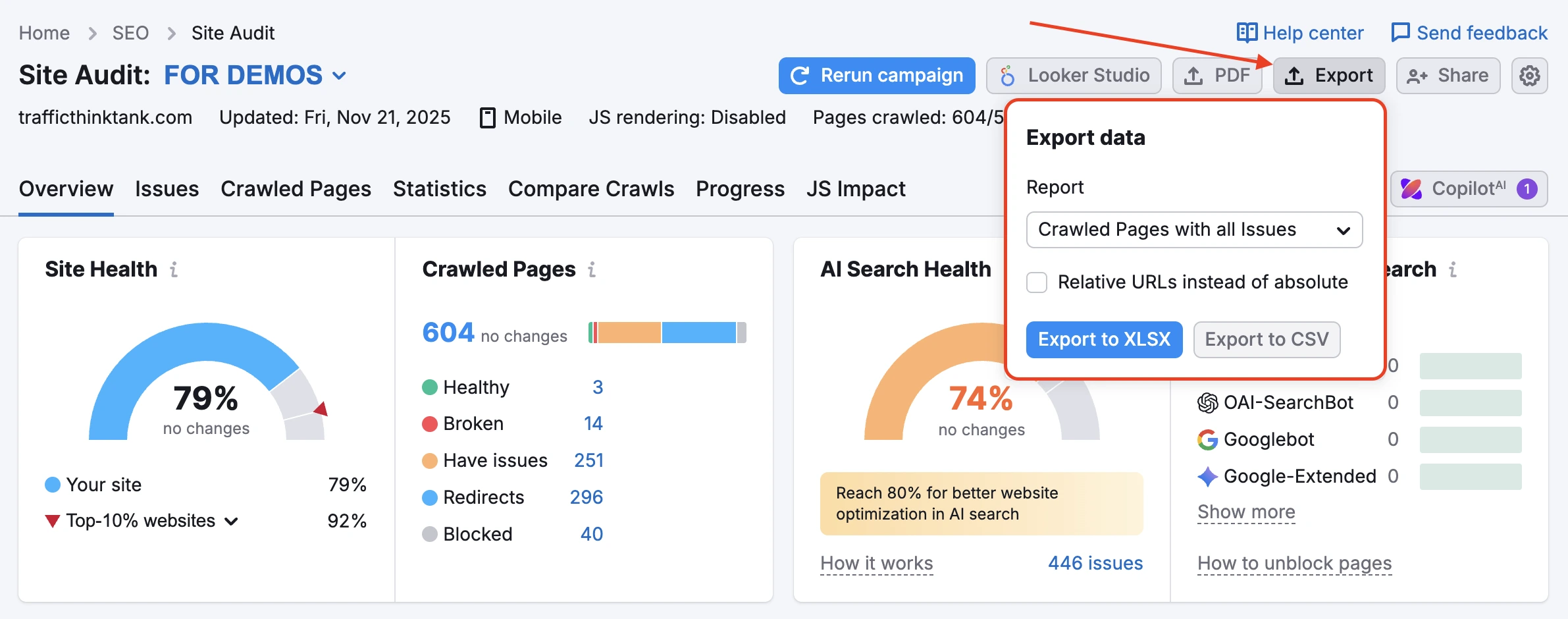
Semrush delivers the most complete technical audit engine, running over 130 checks across Core Web Vitals, schema markup, and crawl barriers. Ahrefs provides a solid, reliable site audit tool with clean internal link analysis, whereas SpyFu offers no technical website auditing capabilities. Use our technical SEO checklist to prioritize your audit fixes.
Remember, an SEO audit tool only highlights technical flaws; you or your developer must execute the actual fixes.
Local SEO: Which Tool Helps Local Businesses?
Winner: Semrush
Semrush provides the most comprehensive local SEO tools, including automated GBP management, localized grid rank tracking, review responses, and directory distribution. By combining rank tracking with localized local SEO and AI search strategy, brick-and-mortar brands can dominate local pack visibility.
Ahrefs and SpyFu offer limited local management features, relying primarily on high-level organic metrics. Note that Semrush Local functions as an add-on module starting at $30 to $60 per location per month.
AI Search Visibility: Can These Tools Track ChatGPT and AI Overviews?
Winner: Semrush
Measuring visibility across generative engines is critical because platforms like ChatGPT, Gemini, and Perplexity synthesize answers from trusted sources instead of just displaying blue links. Tracking brand mentions and citations ensures your content shapes AI-generated answers as outlined in our generative engine optimization guide.
Semrush leads this space through Semrush One, offering prompt tracking, AI citation health checks, and visibility scoring across LLMs. Ahrefs tracks LLM mentions and share of voice across seven AI platforms using Brand Radar, while SpyFu offers basic mention and sentiment checks through SpyGPT.
When optimizing for AI visibility, align your technical groundwork directly with Google’s own guidance on AI features to ensure search crawlers can index and cite your primary pages properly.
H2: Ahrefs vs SpyFu vs Semrush Pricing in 2026: What You Will Actually Pay
Understanding true software costs requires looking beyond headline monthly rates to evaluate additional seats, add-ons, and daily credit caps.
| Tool | Entry Plan | Mid Plan | Higher Plan | Who It Suits |
| Ahrefs | Starter (29/mo)/Lite(129/mo) | Standard ($249/mo) | Advanced ($449/mo) | Solopreneurs, link builders, and SEO agencies |
| Semrush | Pro ($139.95/mo) | Guru ($249.95/mo) | Business ($499.95/mo) | Multi-channel teams, local businesses, and growth agencies |
| SpyFu | Basic ($39/mo) | See live pricing page | See live pricing page | Budget-conscious marketers and PPC research specialists |
Hidden Costs Most Reviews Skip
- Ahrefs Starter & Credit Limits: The $29 Starter plan includes only 1 project and 200 monthly credits. Power users can quickly run through credits while doing deep keyword or backlink research.
- Team Seat Extensions: Base plans usually include login access for a single user. Adding team seats costs roughly $45 to $80 per user per month on Semrush and $40 to $80 on Ahrefs.
- Semrush Add-Ons & Content Tools: Local listing management costs roughly $20 to $60 per location monthly, while advanced content optimization tools require upgrading to Guru or higher.
- Billing Intervals & Currency Conversion: Annual billing saves roughly 15% to 17% overall, but monthly plans incur full fees. International buyers billed in USD may also face bank foreign exchange conversion charges.
Always verify current plan details and billing policies on the official Ahrefs pricing page and Semrush pricing page before making a purchase.
Which Tool Should You Pick? Find Your Situation
Selecting the right platform depends entirely on your operational goals, team size, and monthly software budget.
| If you are… | Best pick | Why | Watch out for |
| Beginner under $50/mo | SpyFu | Provides unlimited search data exports and historical PPC metrics at $39/month. | Lacks website crawling, site audits, and local SEO tracking entirely. |
| Freelancer | Ahrefs | Unmatched backlink precision and keyword difficulty metrics keep client reporting accurate. | Entry plan ($29) limits usage to 1 project and 200 monthly credits. |
| Small local business | Semrush | Native local listing distribution, local map pack tracking, and GBP integration. | Local listing management functions as an add-on monthly subscription fee. |
| Multi-client agency | Semrush | Covers technical audits, content strategies, client pitch reports, and local tracking. | Adding extra team seats (45–100/mo each) quickly raises monthly bills. |
| Ecommerce store | Semrush | Ideal for large-scale site health monitoring, technical audits, and intent mapping. | Keyword rank tracking limits fill up fast with vast product catalog URLs. |
| PPC Specialist | SpyFu | Access years of historical Google Ads copy, bid histories, and competitor ad budgets. | Organic search database is smaller compared to dedicated SEO platforms. |
| Link Builder / PR | Ahrefs | Fastest web crawler (AhrefsBot) for discovering live, broken, and lost backlink equity. | Advanced SERP comparison and bulk link export features require higher plan tiers. |
| AI search researcher | Semrush | Tracks brand citations, share of voice, and prompts across ChatGPT, Gemini, and Perplexity. | Native generative search monitoring requires Semrush One tiers starting at $199/month. |
If your needs span two different categories, start with the lower-priced platform first and re-evaluate your actual usage after 60 days before upgrading.
5 Mistakes to Avoid When Choosing an SEO Tool
- Choosing based on price alone: Picking the cheapest tool without checking limits often leads to hidden costs, restrictive export quotas, or buying separate add-ons later.
- Treating search volume numbers as exact facts: Every platform uses different data sources, so treat volume metrics as relative ranges rather than absolute traffic guarantees.
- Ignoring hidden add-on costs: Always factor in additional team seat fees, local listing charges, and credit top-ups before committing to a monthly tier.
- Buying software without an execution plan: Collecting endless keyword and backlink metrics is useless unless you have a structured workflow to implement actual website updates.
- Skipping free trials and test runs: Test platform workflows with your own domain, such as via Semrush’s 7-day trial or SpyFu’s money-back window, to verify data accuracy before paying. Digimastreys helps growth-focused marketing teams translate raw tool data into structured SEO, AEO, and GEO execution plans that build lasting search visibility.
Can You Use Two SEO Tools Together?
Yes, combining tools is common for marketers who need hyper-specialized data across both organic and paid channels.
- Ahrefs + Semrush: Pairs Ahrefs’ backlink accuracy with Semrush’s local SEO and intent-driven keyword research.
- Semrush + SpyFu: Combines Semrush’s site auditing and rank tracking with SpyFu’s low-cost, historical Google Ads intelligence.
- Ahrefs + SpyFu: Connects top-tier link-building intelligence with deep historical PPC competitor research on a budget.
However, stacking subscriptions quickly doubles your monthly software expenses. A smarter approach is using one primary paid tool alongside free platforms like Google Search Console and Google Analytics to track performance effectively.
Bottom Line: Which One Should You Choose?
- Choose Ahrefs if your growth depends on link building, backlink accuracy, and precise organic keyword research.
- Choose Semrush if you need a complete all-in-one suite covering technical site audits, local listing management, and AI search visibility.
- Choose SpyFu if you want budget-friendly PPC competitor research, historical ad archives, and keyword gap analysis under $40 a month.
An SEO platform provides the data, but your execution strategy earns the actual rankings. If you need help turning raw search data into measurable organic growth, Digimastreys provides guided SEO, AEO, and GEO strategies tailored to your business goals.
Frequently Asked Question
Is SpyFu as good as Semrush?
SpyFu is better for budget PPC competitor research and historical ad copy analysis, but it lacks Semrush’s website crawling, technical site audits, and local SEO tools.
Is Ahrefs better than Semrush for beginners?
Neither is built explicitly for beginners, but Ahrefs has a slightly cleaner interface. Semrush offers more total tools, which creates a steeper initial learning curve.
Which tool is best for local SEO?
Semrush is the clear winner for local SEO, offering native local listing distribution, local review management, and local map pack rank tracking down to specific ZIP codes.
Which is cheapest in 2026?
Ahrefs offers a limited Starter plan at $29/month, but SpyFu’s $39/month Basic plan is the cheapest option providing full competitor research without strict daily usage credit limits.
Do I need more than one SEO tool?
Most businesses only need one main platform like Semrush or Ahrefs combined with free tools like Google Search Console. Stacking multiple subscriptions usually creates unnecessary software expenses.
Which tool tracks AI search visibility?
Semrush offers native AI visibility tracking via Semrush One. Ahrefs tracks LLM mentions through Brand Radar, while SpyFu provides basic brand checks using SpyGPT.
Is a paid SEO tool worth it for a small site?
Paid tools are worth it if you actively publish content or run PPC campaigns. However, small websites with minimal budgets should start with free tools like Google Search Console first.

SNEHA PRAMAL
Sneha Pramal is a content writer focused on creating clear, engaging, and useful digital content.
Sneha Pramal is a content writer focused on creating clear, engaging, and useful digital content.