







Choosing between Ahrefs and Semrush is tough. You are about to spend $100 to $450 every month, so making the wrong choice hurts your budget.
Most reviews give you vague answers like “it depends on your needs.” We will not do that. This updated 2026 Ahrefs vs Semrush comparison looks directly at pricing, real features, and daily workflow.
Whether you run a blog, handle client sites, or manage an e-commerce store, you need clear facts to make the right choice. We tested both tools across keyword research, backlink audits, and AI search tracking to find the clear winner for every use case.
By the end, you’ll know which one to buy.
Ahrefs vs Semrush: The Quick Answer
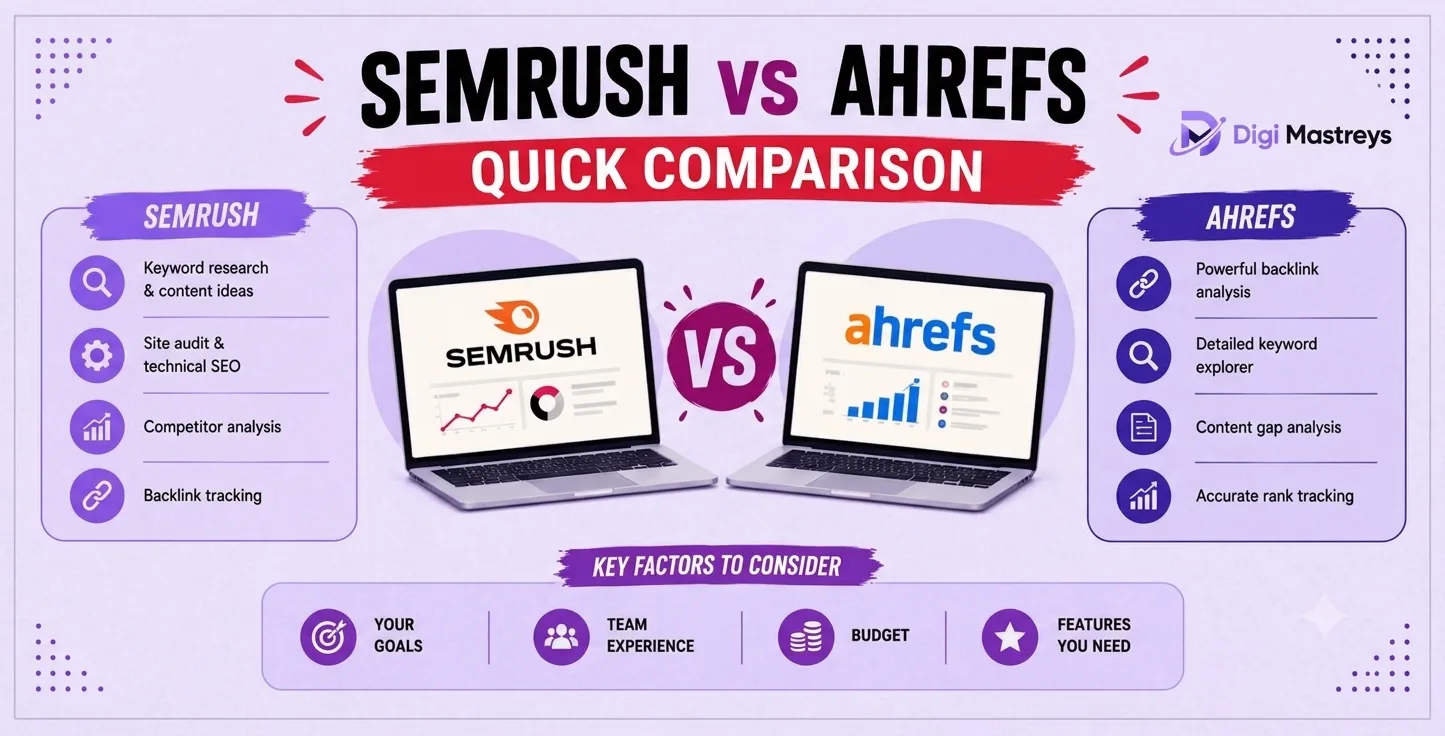
Ahrefs is stronger for backlink research, keyword depth, and clean SEO-only workflows. Semrush is stronger as an all-in-one digital marketing platform that combines SEO, PPC advertising, content tools, local SEO, and client reporting. Pricing lands close across their main tiers, but extra costs for add-ons, seats, and updates differ. Neither tool is universally better; the right choice depends entirely on your daily tasks and budget.
Best for Backlinks: Ahrefs
Ahrefs wins for link building because of its massive live index and fast link discovery [VERIFY]. If you spend your days analyzing competitor link profiles or running outreach, Ahrefs feels sharper and more reliable.
Best All-in-One Platform: Semrush
Semrush covers marketing channels far beyond organic search. It includes a full suite for paid search (PPC), social media, and content marketing, saving you from buying separate tools.
Pricing: Close, but Add-Ons Differ
Ahrefs starts cheaper with its Lite tier and $29 Starter plan, while Semrush begins with its SEO plan at $139.95. However, Semrush includes daily rank tracking, whereas Ahrefs charges extra for daily updates.
Keyword Research: Different Strengths
Ahrefs provides click-through data and traffic potential to show real search behavior. Semrush uses its Keyword Magic Tool to group thousands of terms into tidy topic clusters with clear search intent tags.
Rank Tracking and Local SEO: Semrush Wins
Semrush includes daily rank tracking and a complete local SEO toolkit with map tracking and listing management. Ahrefs requires paid add-ons for daily tracking and lacks built-in local citation features.
AI Visibility Tracking: Both Offer It
Both platforms now track how your brand appears in modern AI search tools. Ahrefs uses Brand Radar, while Semrush offers an AI Toolkit covering ChatGPT, Perplexity, and Google AI Overviews.
Final Pick: Depends on Your Workflow, Here’s How to Decide
Choose Ahrefs if you focus purely on technical SEO and link building. Choose Semrush if you manage paid ads, local listings, and client-ready reporting under one roof.
Ahrefs vs Semrush Features
Ahrefs excels at deep technical SEO and backlink data, while Semrush provides a wider toolkit for multi-channel digital marketing. Comparing their key features side by side helps you see where each platform spends its resources.
| Feature | Ahrefs | Semrush | Better for |
| Keyword database | 28.7B | 28.8 | Ahrefs (Global size) |
| Backlink index | 35T live | 43T live & dead | Ahrefs (Live freshness) |
| Site audit checks | 170+ | 140+ | Ahrefs (Technical depth) |
| Daily rank tracking | Extra cost per project | Included | Semrush (Included default) |
| PPC tools | No | Yes | Semrush (PPC advertisers) |
| Local SEO | Limited | Full suite | Semrush (Local businesses) |
| Content tools | Content Explorer | Content Marketing Toolkit | Semrush (Workflow & briefs) |
| AI visibility | Brand Radar (496M+ prompts) | AI Toolkit (239M+ prompts) | Tie (Different metrics) |
| Free trial | No (Free Webmaster Tools) | 7 days | Semrush (Trial testing) |
| API access | Conflicting [VERIFY] | Business plan [VERIFY] | Tie |
Ahrefs vs Semrush Pricing
Both platforms start around $130 to $140 per month for standard professional use, though Ahrefs offers a entry-level $29 Starter plan [VERIFY]. Prices vary depending on monthly versus annual billing, so check the official Ahrefs pricing and Semrush pricing pages for the latest updates.
| Tier | Ahrefs | Semrush | Who it’s for |
| Entry | Starter ($29/mo) | No equivalent plan listed | Budget beginners & solo researchers |
| Main | Lite ($129/mo) | Pro ($139/mo) | Freelancers & small site owners |
| Mid-Tier | Standard ($249/mo) | Guru ($249/mo) | Growing in-house teams & agencies |
| Advanced | Advanced ($449/mo) | Business ($499/mo) | Large enterprises & heavy data users |
Ahrefs vs Semrush for Keyword Research
Semrush is better for building large content plans because of its intent tags, topic clusters, and Personal Keyword Difficulty scores. Ahrefs is better for judging whether a single keyword is actually worth targeting thanks to its Traffic Potential, real click data, and Parent Topic matching.
Where Semrush Wins
- Keyword Magic Tool: Generates thousands of keyword variations organized neatly into topic clusters.
- Search Intent Filters: Automatically tags keywords as informational, commercial, navigational, or transactional so you can sort your funnel instantly.
- Personalized Difficulty: Adjusts keyword difficulty scores based on your specific domain authority rather than a blanket average.
Where Ahrefs Wins
- Clicks Data: Shows how many users actually click through to a result, accounting for search features that eat up traffic.
- Traffic Potential: Estimates the total organic traffic a page can earn by ranking for a main term and all related variations combined.
- Parent Topic Matching: Tells you if a keyword can be grouped under an existing page or if it requires a fresh URL.
Both platforms offer massive keyword databases, with Ahrefs sitting around 28.7 billion and Semrush around 26.7 billion
Want a cheaper option? See our comparison of Ahrefs vs KWFinder.
Backlink Analysis: Who Has Better Link Data?
Ahrefs is the preferred choice for deep backlink research and fast link prospecting, while Semrush offers a larger total index along with built-in outreach and toxic link tools. When comparing their databases, remember that Ahrefs’ 35 trillion live backlinks and Semrush’s 43 trillion live-plus-dead backlinks are not an apples-to-apples comparison. Semrush counts dead and historical links to boost its raw volume, whereas Ahrefs focuses heavily on live link discovery speed.
Choose Ahrefs for:
- Faster Discovery: Its crawler surfaces new backlinks much faster, keeping you updated within hours of a link going live.
- Industry Standard Metrics: Domain Rating (DR) is widely recognized and used by link builders globally for prospect qualification.
- Clean Prospecting: Site Explorer lets you filter through massive link profiles without clutter.
Choose Semrush for:
- Toxic Link Audits: Built-in toxicity scores help you spot harmful links and send disavow files directly to Google.
- Managed Outreach: Its Link Building Tool works like a CRM to track email outreach and campaign progress in one place.
- Backlink Gap Analysis: Quickly find domains linking to multiple competitors but missing from your profile.
Site Audit and On-Page SEO: Which Tool Finds More Issues?
Both platforms run thorough technical site audits, with Ahrefs checking over 170 issues and Semrush scanning over 140 parameters. Ahrefs provides a cleaner, more visual interface that is easy to share with clients, while Semrush delivers deeper actionable fix suggestions and step-by-step on-page optimization tasks.
- Crawl Limits: Ahrefs crawls more pages per project on average, making it ideal for massive enterprise websites.
- JavaScript Rendering: Both platforms handle JavaScript execution, but Semrush sometimes restricts advanced rendering features to higher-priced plans [VERIFY].
- On-Page Optimization: Semrush includes a dedicated On-Page SEO Checker that compares your pages directly against top Google competitors.
- Always-On Monitoring: Ahrefs offers continuous background crawls to catch technical errors as soon as they happen.
Once you complete your site scan, you can follow our comprehensive technical SEO checklist 2026 to resolve critical errors and improve crawl budget efficiency.
Rank Tracking, Local SEO, PPC and Reporting
Semrush covers more digital marketing channels than Ahrefs right out of the box.
Rank Tracking
Semrush includes daily rank tracking, automated alerts, and SERP feature monitoring in its base plans at no extra cost. Ahrefs provides reliable position tracking, but daily updates require a paid Project Boost add-on. If daily tracking is part of your core workflow, Semrush saves you money.
Local SEO
Semrush offers a built-in local SEO suite featuring listing management, map rank tracking, and customer review analysis. Ahrefs does not have a native local SEO toolkit [VERIFY], meaning you must rely on external platforms if managing physical business locations is a priority.
PPC Tools
Semrush includes comprehensive paid search tools that let you research competitor ad copy, keyword bidding strategies, and historical ad budgets. Ahrefs focuses entirely on organic search and provides zero paid advertising or PPC features.
Client Reporting
Semrush features a mature reporting setup with automated PDF delivery, white-label options, and direct third-party integrations. Ahrefs offers a Report Builder tool, but it operates as a paid add-on and lacks the same depth of scheduling and agency branding features.
AI Visibility: Ahrefs Brand Radar vs Semrush AI Toolkit
Both Ahrefs and Semrush track how your brand appears inside modern AI search tools like ChatGPT, Perplexity, and Google AI Overviews, with Ahrefs leading on raw prompt scale and Semrush focusing heavily on strategic recommendations. In simple terms, AI visibility tracking checks whether conversational search engines mention your business when users ask industry-related questions. As search shifts toward direct answers, knowing your AI footprint is vital.
Here is how their AI tracking features compare:
- What it tracks: Ahrefs Brand Radar monitors brand presence across major AI indexes and traffic shifts, while the Semrush AI Toolkit analyzes sentiment, market share, and product perception.
- What it costs: Both platforms typically package these capabilities into specialized add-on tiers or higher plans, running around $99/month for dedicated index tracking.
- Who needs it: Any brand or agency heavily impacted by Google AI Overviews and ChatGPT recommendations needs this data to protect organic visibility.
Keep in mind that vendor prompt numbers, such as Ahrefs’ claimed 496M+ prompts versus Semrush’s 239M+,are self-reported and should be treated as directional metrics rather than absolute guarantees. To understand how Google structures these results, review Google’s AI features documentation. If you are new to optimizing for answer engines, our complete Generative Engine Optimization guide walks you through strategies to increase visibility across ChatGPT, Perplexity, and Google AI Overviews.
Is Ahrefs Worth It?
Yes, Ahrefs is worth it if backlink analysis, competitor research, and clean SEO data are central to your daily work, but it is not worth it if you need PPC tools, local SEO, or a low-cost entry plan.
Ahrefs Is Worth It If…
- You Live in Backlink Data: Your daily workflow relies heavily on tracking fresh links, analyzing competitor link profiles, and running outreach campaigns.
- You Want a Focused UI: You prefer a clean, uncluttered interface that stays strictly dedicated to organic search and technical performance.
- You Manage a Single Site on a Budget: You can take advantage of free Ahrefs Webmaster Tools to monitor your own verified website without paying a monthly fee.
Skip Ahrefs If…
- You Run PPC Campaigns: You need paid search advertising data, ad copy research, or multi-channel digital marketing metrics.
- You Do Local SEO: Your business or client base requires map rank tracking, citation building, and Google Business Profile management.
- You Want an All-in-One Suite: You prefer paying for a single platform that covers social media, content creation briefs, and automated white-label client reports out of the box.
Semrush or Ahrefs: Which One Fits Your Situation?
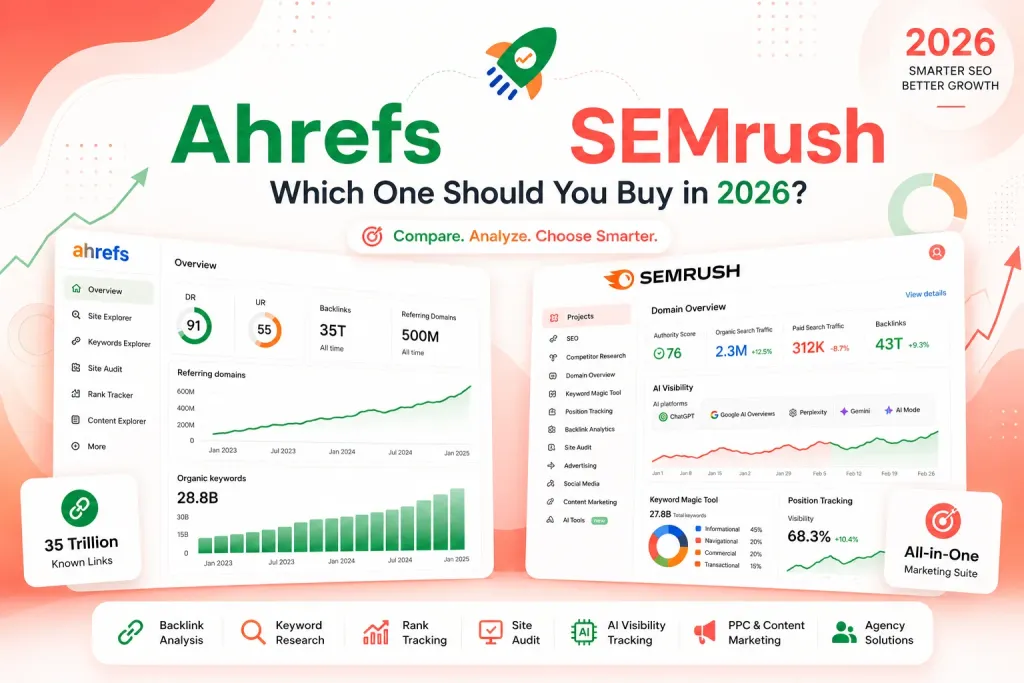
Your ideal platform depends entirely on your daily tasks, client requirements, and budget.
| Your situation | Better pick | Why |
| “I’m a beginner with a small blog and limited budget” | Ahrefs | Free Webmaster Tools and low-cost entry plans fit tight budgets. |
| “I’m a freelancer doing SEO for a few clients” | Semrush | All-in-one tools cover keyword research, audits, and tracking efficiently. |
| “I run an agency with 10+ clients and need reports” | Semrush | Built-in white-label reporting saves hours of manual work. |
| “I mostly do link building and outreach” | Ahrefs | Unmatched live backlink index and fast discovery speed. |
| “My client is a local business” | Semrush | Dedicated local rank tracking and listing management suite. |
| “I run SEO and paid ads together” | Semrush | Combines organic search data with full PPC competitor insights. |
Semrush Alternatives Worth Trying
If both Semrush and Ahrefs stretch your budget too far, several alternative platforms deliver solid search data at a fraction of the cost.
- SE Ranking: An excellent mid-tier all-in-one suite with accurate rank tracking, though its keyword database is smaller than the top platforms.
- Ubersuggest: A budget-friendly tool ideal for basic keyword research and site audits, though its link data is significantly less detailed. For a deeper look, see our detailed Ubersuggest vs Ahrefs breakdown.
- KWFinder (Mangools): Great for intuitive keyword difficulty analysis and quick research, though it lacks comprehensive technical site audit tools.
- Google Search Console & Keyword Planner: Free first-party Google tools offering exact performance and search volume data, though they provide no competitor analysis features.
Bottom Line
Choose Ahrefs if your daily work focuses heavily on technical SEO, link building, and clean backlink analysis. Go with Semrush if you need an all-in-one platform that handles local SEO, paid ads, content planning, and agency reporting under one roof. Before committing to a monthly subscription, test the waters using the Semrush free trial or set up free Ahrefs Webmaster Tools for your own site. Explore our latest optimization guides on Digimastreys to keep scaling your organic search performance.
Frequently Asked Questions (FAQs)
1. Is Ahrefs worth it in 2026 for small website owners?
Yes, Ahrefs is worth the investment if your SEO strategy relies heavily on technical audits, competitor research, and backlink analysis. However, if you are a beginner on a tight budget, starting with free options like Ahrefs Webmaster Tools or Google Search Console gives you primary data without the monthly cost.
2. What’s better: Semrush or Ahrefs for overall digital marketing?
Semrush is better if you need an all-in-one suite covering organic SEO, PPC ad research, local citation management, social media, and client reporting. Ahrefs is better if your sole focus is pure search engine optimization, technical site health, and backlink prospecting.
3. Which is better for backlink analysis: Ahrefs or Semrush?
Ahrefs is generally considered better for backlink analysis due to its faster live crawler, clean Domain Rating (DR) metrics, and focus on active referring domains. While Semrush reports a larger raw backlink index, it includes a significant amount of historical and unconfirmed links.
4. Why are rankings different on Semrush than Ahrefs?
Rankings differ between Semrush and Ahrefs because each platform uses different crawling schedules, data update frequencies, localized data centers, and device settings (mobile vs. desktop). Additionally, search engines dynamically serve personalized SERPs based on location and real-time user signals.
5. Does Semrush or Ahrefs have a free trial?
Semrush offers a standard 7-day free trial that gives you full access to test its Pro or Guru features before paying. Ahrefs does not offer a free trial for its paid plans, but site owners can use Ahrefs Webmaster Tools for free to audit their own verified domains.
6. Can I use Ahrefs and Semrush together for my agency?
Yes, many agencies use both platforms to complement each other. They often rely on Ahrefs for deep backlink audits and technical link building, while using Semrush for content marketing workflows, local rank tracking, PPC intelligence, and white-label client PDF reports.
7. How do Ahrefs and Semrush track AI visibility in search?
Ahrefs uses Brand Radar to track brand mentions across millions of prompts in LLM search platforms, while Semrush provides an AI Toolkit that evaluates sentiment, share of voice, and product positioning in conversational engines like ChatGPT, Perplexity, and Google AI Overviews.

SNEHA PRAMAL
Sneha Pramal is a content writer focused on creating clear, engaging, and useful digital content.
Sneha Pramal is a content writer focused on creating clear, engaging, and useful digital content.