






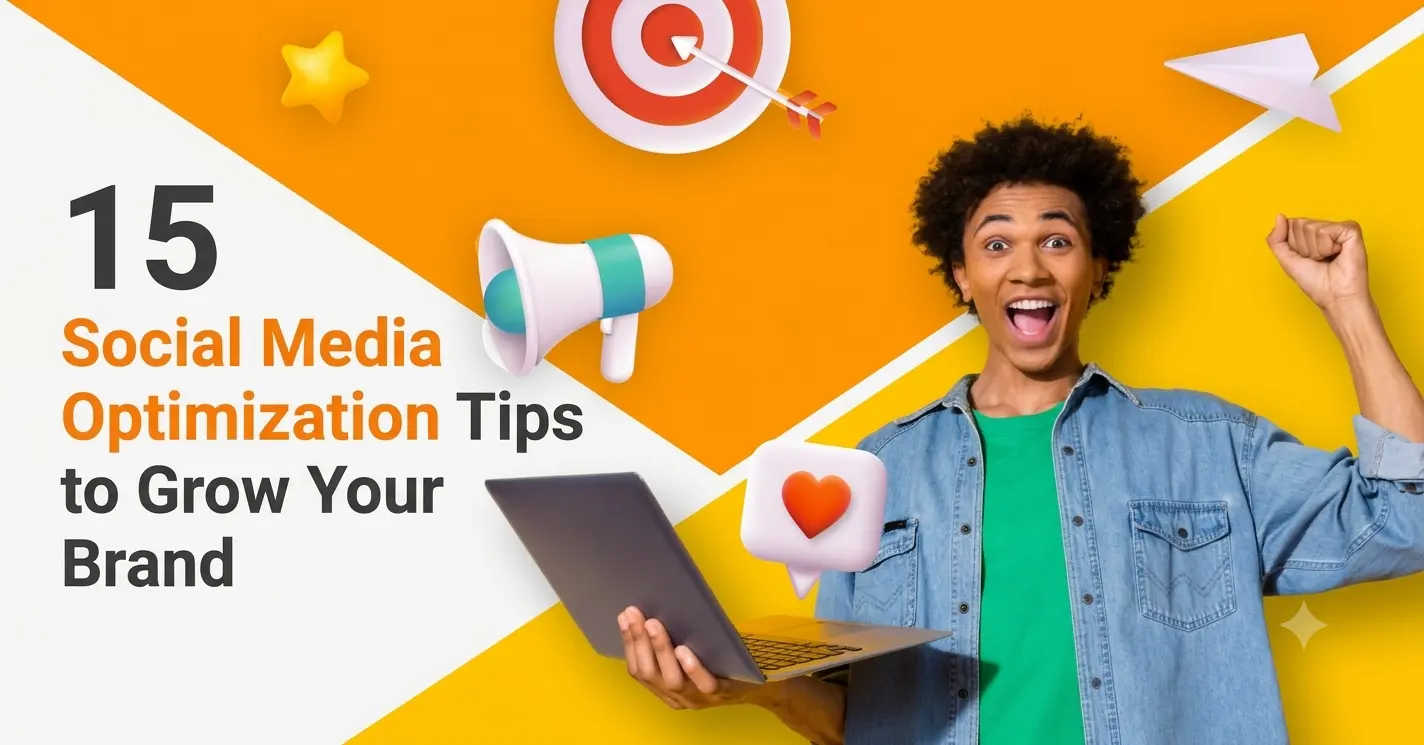
Are you tired of posting on social media every single day, only to see silence, low reach, and zero engagement? You put hours into designing graphics and writing captions, but the algorithm just ignores your hard work. Social media optimization, or SMO, solves this exact problem by fine-tuning your profiles and content so platforms and users can actually find you. In this guide, Digimastreys shares 15 practical optimization tips, essential metrics, tool comparisons, and a clear starting plan tailored to your exact business situation. Say goodbye to guesswork and start growing your brand organically today.
What Is Social Media Optimization?
Social media optimization, or SMO, is the systematic process of refining your social media profiles, content, and posting strategies to maximize brand visibility and user engagement. It includes optimizing bio keywords, structuring multimedia content, improving accessibility, and tracking performance through data analytics. SMO helps brands grow by making content easily discoverable when target audiences search directly inside social apps. Furthermore, strong social optimization feeds modern search engines and AI-driven answer engines, ensuring your brand surfaces accurately across Google AI Overviews, ChatGPT, and Perplexity search results.
Keypoints:
- Built-in Discoverability: SMO turns standard social profiles into magnets that attract high-intent users organically.
- In-App Keywords: Social search bars now rival traditional search engines for everyday product discovery.
- Complete Profiles: Clear bios with exact service terms help algorithms categorize your business instantly.
- Balanced Content Mix: Quality educational posts build trust long before you pitch a paid offer.
- Short-Form Video Dominance: Reels and shorts capture immediate attention and push content beyond current followers.
- Active Community Dialogue: Replying to early comments signals high value to platform distribution feeds.
- Data-Driven Tracking: Regular metric reviews help you double down on tactics that actually drive revenue.
What Is Social Media Optimization (SMO)?
Social media optimization, commonly known as SMO, is the practical process of improving your profiles and content so search algorithms and users can easily discover your brand. Think of it as fine-tuning your online presence to turn passive scrollers into loyal customers without relying solely on paid ads.
SMO covers four main pillars to keep your marketing focused:
- Profile setup: Crafting clear bios, correct links, and searchable handles.
- Content creation: Publishing helpful text, visuals, and short videos that resonate.
- Active engagement: Replying to comments and building genuine conversations.
- Data analytics: Tracking click rates and reaching to see what works.
Today, platforms like Instagram and TikTok function just like search engines. Being findable through targeted keywords matters far more than simply being seen in a crowded feed.
SMO vs SMM vs SEO: What’s the Difference?
People often confuse social media optimization with other digital marketing terms. Knowing the exact differences helps you build a smarter plan.
| Factor | SMO | SMM | SEO |
| Main goal | Profile visibility and in-app reach | Paid ads, community, and direct sales | Organic search engine rankings |
| Where it happens | Social networks and apps | Social platforms and ad networks | Google, Bing, and search engines |
| Paid or organic | Mostly organic | Paid and organic | Organic |
| Key tactics | Bio keywords, hashtags, posting times | Ad targeting, funnels, sponsored posts | Technical health, backlinks, on-page text |
| How you measure it | Reach, shares, engagement rate | ROAS, CPA, ad conversions | Rankings, organic traffic, leads |
When combined properly, these three channels create a powerful marketing ecosystem. For instance, strong organic search traffic feeds your social channels, while optimized social profiles amplify your overall brand authority. Many growing brands rely on integrated social media marketing for businesses to align these efforts seamlessly.
Why Social Media Optimization Matters for Your Brand
Social media optimization matters because it transforms neglected profiles into active growth engines that build trust, drive website traffic, and capture high-intent buyers. With global user growth continuing to surge as reported by DataReportal, ignoring optimization means losing visibility to competitors.
- Enhanced visibility: Optimized content surfaces directly in crowded feeds and recommendation engines.
- Brand trust: Consistent bios and helpful answers establish immediate credibility with strangers.
- Website traffic: Clear links and calls-to-action drive interested scrollers straight to your landing pages.
- Higher engagement: Structured posts invite comments, turning passive viewers into active community members.
- AI discoverability: Clean social data helps modern answer engines accurately index your brand name.
While social signals are not a direct Google ranking factor, strong social activity drives branded search queries and extends your content reach.
15 Social Media Optimization Tips That Actually Work
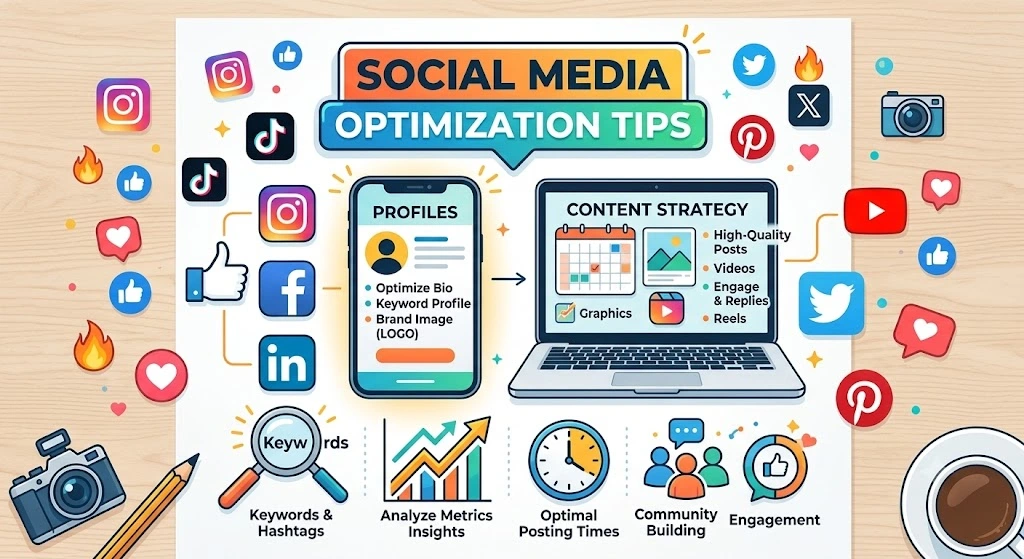
These fifteen practical optimization tips are organized into four simple categories: Profile and Discoverability, Content, Engagement, and Measurement and Growth. You can start with whichever area your business needs most. A handy “Where should you start?” The comparison table follows right after the tips to guide you.
Part 1: Optimize Your Profile and Make It Searchable
Tip 1: Choose Platforms Based on Where Your Audience Is
Choosing the right social media platforms depends entirely on where your target audience spends their time, not on passing industry trends.
Spreading your efforts across six different networks usually lowers your content quality and exhausts your team. Instead, pick two to three core platforms that match your business model. For instance, a B2B SaaS company belongs on LinkedIn, while a visual lifestyle brand thrives on Instagram.
Quickly check your platform choice with these three rules:
- Verify your buyers actively use the app daily.
- Match your content format (text, video, image) to the platform’s strengths.
- Ensure your team can maintain a consistent posting schedule there.
Tip 2: Keep Your Name, Handle, and Brand Voice Consistent
Using the exact same brand name, handle, high-resolution logo, and color palette across every social network builds immediate recognition. Put together a brief style guide that outlines your brand voice, preferred emoji usage, and hashtag limits. This visual and tonal alignment helps both human users and search algorithms recognize your business as one unified digital entity.
Tip 3: Write a Keyword-Rich Bio That Says What You Do
A strong bio needs a clear formula to convert casual profile visitors into loyal followers. Use this proven structure: What you do + Who you help + Proof + Call to Action.
Knowing how to optimize your social media profile starts with placing your primary keyword directly in your display name or bio text so your account surfaces easily in in-app search results.
Before: We help businesses grow online Check out our blog.
After: SEO & Digital Marketing Agency | Helping local brands scale traffic | 500+ audits completed | Grab our free audit checklist below.
Tip 4: Add a Clear Link in Bio and Track It with UTMs
Your social link in bio should have one specific goal, such as driving traffic to a cornerstone blog post, a lead magnet, or a product page. Since you want to measure your return on investment, always attach UTM parameters to your links. UTM tags are simple text snippets added to your URLs that let Google Analytics show you exactly which social network or post brought visitors to your site.
A clean tracking link looks like: [yourwebsite.com/page?utm_source=instagram&utm_medium=social&utm_campaign=bio_link](https://yourwebsite.com/page?utm_source=instagram&utm_medium=social&utm_campaign=bio_link).
Pairing these tracked links with high-converting, SEO-friendly content ensures every click translates into meaningful website engagement.
Part 2: Optimize Your Content
Tip 5: Build 3-5 Content Pillars and Balance Your Content Mix
Focusing your social media efforts on three to five core content pillars stops you from posting random updates. A balanced mix keeps followers interested without feeling overwhelmed by constant sales pitches. Use the eighty-twenty rule as your baseline: give away eighty percent pure value, education, and entertainment, and save only twenty percent for direct product promotions.
Here are four simple content pillars for a digital marketing brand:
- Educational tips on technical search optimization
- Behind-the-scenes agency workflow look
- Client success metrics and case studies
- Quick answers to common audience questions
Tip 6: Use Keywords in Captions, Alt Text, and Hashtags
Social apps read your captions, on-screen text, and image alt text to figure out who wants to see your post. Place your primary keywords naturally in the first line of your caption, inside your graphic text, and within the accessibility alt-text box. Add three to five targeted hashtags at the end. Never stuff keywords unnaturally, as platforms flag spammy behavior instantly.
- Do: Write clear descriptive alt text for every image.
- Do: Pick relevant niche hashtags that match user search intent.
- Don’t: Hide walls of irrelevant keywords at the bottom of posts.
- Don’t: Repeat the exact same hashtag block on every single update.
Tip 7: Use Short-Form Video and Carousels
Social apps read your captions, on-screen text, and image alt text to figure out who wants to see your post. Place your primary keywords naturally in the first line of your caption, inside your graphic text, and within the accessibility alt-text box. Add three to five targeted hashtags at the end. Never stuff keywords unnaturally, as platforms flag spammy behavior instantly.
- Do: Write clear descriptive alt text for every image.
- Do: Pick relevant niche hashtags that match user search intent.
- Don’t: Hide walls of irrelevant keywords at the bottom of posts.
- Don’t: Repeat the exact same hashtag block on every single update.
Tip 8: Adjust Your Tone for Each Platform
Posting the exact same copy across every social network alienates users because each platform has its own distinct audience culture. While your core brand values stay identical everywhere, you should adapt your delivery style to match the expectations of each app’s community.
Here is how your tone shifts across major platforms:
- LinkedIn: Professional, clear, and focused on industry insights, data, and career development.
- Instagram: Visual, conversational, and lighthearted with relatable stories and clean aesthetics.
- X (Twitter): Concise, direct, and focused on timely news or quick, opinionated commentary.
Tip 9: Post Consistently with a Content Calendar
Consistency always beats raw posting volume when building an audience. Instead of scrambling to create graphics daily, batch your content weekly and schedule updates ahead of time. Rather than relying on generic internet charts for the best posting times, check your own platform analytics to see when your followers are actually online. Test one specific time slot for two full weeks to gather reliable reach metrics.
Organizing your publishing schedule through a structured content calendar guide helps you stay disciplined and keeps your content pipeline filled without last-minute stress.
Part 3: Boost Social Media Engagement
Tip 10: Reply Fast and Ask Questions That Invite Answers
Replying within the first hour of posting signals to platform algorithms that your content is generating high interest. Always end your comments with a quick question to keep the conversation flowing naturally. For customer support issues, address the concern politely and move the conversation to private messages right away. Using story polls and question stickers also helps boost your overall social media engagement effortlessly.
Example comment reply: “Thanks for reading, Amit! Which of these three tools do you plan to test out first?”
Tip 11: Encourage User-Generated Content and Brand Advocates
User-generated content includes customer photos, reviews, and tagged posts that build social proof. Encourage fans to share by creating a unique branded hashtag and offering simple post prompts. Always ask for permission before resharing user content, and tag the original creator to show appreciation.
Your loyal customers and employees make the best brand advocates for authentic reach. For example, a local coffee shop can repost a customer’s morning latte photo with the caption.
Tip 12: Collaborate with Creators and Join Relevant Communities
Partnering with micro-creators and hosting expert takeovers lets you reach established, trusting audiences fast. You can also join niche Facebook or LinkedIn groups to offer helpful advice, but avoid direct sales pitches that annoy members.
Always evaluate potential partners by looking closely at engagement quality rather than just raw follower counts.
Check these three factors before choosing a partner:
- Audience alignment with your ideal customer profile.
- High comment interaction relative to their total follower size.
- Shared brand values and consistent content quality.
Part 4: Measure and Grow Smarter
Tip 13: Track the Right Metrics and Test One Change at a Time
Reviewing your analytics on a weekly, monthly, and quarterly rhythm keeps your growth strategy on track. When running A/B tests, change only one variable at a time, like your caption, video hook, design format, or posting time, to isolate what works. This systematic approach ensures you build social media engagement based on hard data rather than educated guesses.
| Metric | What It Tells You | How to Calculate |
| Engagement rate | Content relevance & audience interest | (Total Interactions ÷ Reach) × 100 |
| Reach | Total unique users seeing your content | Platform Analytics / Native Insights |
| Click-through rate | Effectiveness of call-to-action & link | (Link Clicks ÷ Impressions) × 100 |
| Follower growth rate | Speed of brand expansion | (New Followers ÷ Total Followers) × 100 |
| Saves and shares | Long-term utility & viral value | Total Saves + Shares Count |
| Conversions | Business impact & sales generated | (Desired Actions ÷ Link Clicks) × 100 |
Tip 14: Use Social Listening and SMO Tools to Save Time
Using dedicated social media optimization tools allows you to schedule posts, monitor brand mentions, and evaluate performance efficiently. However, software should streamline your execution rather than dictate your core strategy. To keep your workflow manageable and budget intact, start by testing just two to three essential platforms before scaling up.
A detailed comparison table covering the top social media optimization tools for scheduling, analytics, and active listening will follow later in this guide.
Tip 15: Make Content Accessible and AI-Search Ready
Designing accessible content expands your reach while making your posts readable for search engines and AI agents. Always add descriptive alt text to images, include closed captions on videos, maintain strong color contrast, and save image files with clear, descriptive names.
Additionally, link your social channels to your website while keeping your brand name and details identical across the web. This structured approach helps search engines verify your business as a single trusted entity. Aligning your profiles with Google’s guide on creating helpful content strengthens your overall search presence and supports your long-term AI Overviews strategy.
Where Should You Start? SMO Plan by Situation
Every business starts from a different baseline. Pick your current situation below to follow a focused 30-day action plan with the most relevant tips.
| Your Situation | Start With These Tips | First 30-Day Action |
| I’m a brand new business | Tips 1, 2, 3, 4 | Optimize profile bios, set up tracking links, and research primary keywords. |
| I post daily but get low engagement | Tips 5, 6, 10, 13 | Audit your content pillars and test ending posts with clear questions. |
| I run a local shop | Tips 3, 6, 11 | Claim local profile names, add geotags, and reshare authentic customer posts. |
| I’m a B2B company | Tips 8, 12, 15 | Build LinkedIn thought-leadership posts and join niche industry groups. |
| I sell products online | Tips 4, 5, 11 | Feature user reviews, link product pages, and run value-driven promo posts. |
| I have no time or team | Tips 9, 14 | Batch create content once weekly and use one scheduling tool. |
Best Social Media Optimization Tools
Choosing the right software stack saves hours of manual work and keeps your publishing workflow organized. Here are six balanced tools across scheduling, design, analytics, and listening:
| Tool | Best For | Key Feature | Free Plan? |
| Buffer | Simple scheduling | Clean multi-platform queue | Yes |
| Hootsuite | Streamlined multi-network planning | Unified content calendar | PRICING/FREE |
| Canva | Social asset creation | Drag-and-drop templates | Yes |
| Metricool | All-in-one analytics & scheduling | Deep competitor tracking | Yes |
| Sprout Social | Enterprise workflows | Advanced social listening | No |
| Brand24 | Reputation monitoring | Real-time web and social alerts | No |
Tip: Choose tools that match your current team size and monthly budget rather than paying for advanced features you do not use yet. Start small and scale up as your traffic grows.
Do You Need a Social Media Optimization Agency or Expert?
Deciding whether to hire outside help depends on your internal bandwidth and growth goals. Partnering with a professional social media optimization agency makes sense when your team lacks the specialized technical skills needed to scale visibility or align platforms with your core brand personality.
5 signs you need help:
- Organic reach and click-through rates have plateaued completely.
- You lack the technical bandwidth to audit alt text, schema, and tracking links.
- Publishing content feels chaotic due to an inconsistent posting calendar.
- You cannot keep up with changing AI-search indexing rules and algorithm updates.
- Your internal team spends too much time guessing what content works.
5 questions to ask before hiring:
- Can you share verified case studies with measurable growth metrics?
- What does your performance reporting and analytics dashboard look like?
- Do you build a custom strategy tailored specifically to our business model?
- Will our company retain full, independent ownership of all social accounts?
- What is your pricing model, and are there any hidden fees?
Here at Digimastreys, we publish practical SEO, AEO, GEO, and social media guides to help you master digital growth. Explore our latest resources and expert insights to level up your organic strategy today.
- Spreading yourself too thin on every platform: Focus on two or three channels where your target audience spends active time.
- Ignoring comments and community interaction: Reply within an hour and end with a question to keep conversations flowing naturally.
- Using inconsistent branding and handles: Keep your profile names, visual style, and brand voice uniform across all networks.
- Using inconsistent branding and handles: Keep your profile names, visual style, and brand voice uniform across all networks.
- Chasing risky algorithm hacks: Prioritize genuine educational value and helpful content over temporary shortcut tricks.
- Buying fake followers or automated engagement: Build a real, trusting audience through organic outreach and genuine community value.
- Ignoring your performance analytics: Review your metrics regularly to double down on what works and drop what fails.
Bottom Line
Mastering social media optimization comes down to four core pillars: perfecting your profiles, publishing valuable content, building active community engagement, and tracking your performance metrics. Aligning these elements builds long-term authority and sustainable organic growth.
Your immediate next step is simple: pick three tips from this guide and apply them consistently for the next 30 days. To continue scaling your organic visibility, explore more of our expert SEO, AEO, and digital marketing guides right here on Digimastreys.
Frequently Asked Questions
What is SMO and what does S.M.O mean?
Social Media Optimization (SMO) means improving your social profiles and content strategy to maximize brand visibility and website traffic. The acronym S.M.O stands directly for Social Media Optimization, focusing on organic reach rather than paid advertising spend.
Is SMO the same as SMM?
No, SMO focuses primarily on organic profile adjustments, community engagement, and search-friendly content sharing. In contrast, Social Media Marketing (SMM) typically includes paid social ads, sponsored campaigns, and direct-response financial investments across digital advertising networks.
How long does SMO take to show results?
Most businesses see noticeable improvements in engagement and profile traffic within three to six months of consistent optimization. Sustainable organic growth requires regular analytics reviews, consistent posting calendars, and ongoing community interaction over time.
Does SMO help SEO?
Yes, strong social optimization indirectly supports SEO by driving referral traffic, boosting brand search volume, and amplifying content reach. Search engines and AI algorithms recognize active, trusted entity signals across multiple interconnected digital platforms.
Can small businesses do SMO without an agency?
Yes, small businesses can easily handle SMO independently by batching content creation, using free scheduling tools, and replying to comments promptly. Success depends more on consistent execution and audience value than on large marketing budgets.

SNEHA PRAMAL
Sneha Pramal is a content writer focused on creating clear, engaging, and useful digital content.
Sneha Pramal is a content writer focused on creating clear, engaging, and useful digital content.