









Quick Answer: Machine learning is a type of artificial intelligence where computers learn patterns from data instead of following fixed, manually written rules. Instead of a programmer telling the computer exactly what to do in every situation, the system studies examples, like past purchases, past emails, or past traffic patterns, and uses what it learns to make predictions on new, unseen data. Netflix recommending a show you’ll probably like, or your bank flagging a suspicious transaction, are both everyday results of machine learning at work.
If you’ve ever typed “what is machine learning” into Google hoping for an answer that doesn’t sound like a textbook, this guide is written exactly for that. No heavy jargon, no assumed coding background, just a clear, practical explanation of what machine learning actually is, how it works, and where you’ll find it in daily life.
What Is Machine Learning?
In the simplest possible words: machine learning is a way of teaching computers to get better at a task by showing them examples, instead of programming every single rule by hand.
Think about how a traditional computer program works. A developer writes exact instructions, “if this happens, do that.” This works fine for simple, predictable tasks like a calculator. But for something like “figure out if this photo contains a cat” or “predict which product this customer will buy next,” writing exact rules for every possibility is nearly impossible. There are too many variations.
This is where machine learning changes the approach. Instead of hand-coding every rule, you give the system a large number of examples, thousands or even millions of labeled photos, past customer purchases, or historical prices, and the system studies those examples to find patterns on its own. Once it has learned those patterns well enough, it can apply them to new data it has never seen before.
A useful way to separate two commonly confused terms:
- Machine learning algorithm: the mathematical method or procedure used to find patterns in data (this exists before training).
- Machine learning model: the actual trained result that comes after the algorithm has studied the data. The model is what actually makes predictions in the real world.
So when people say “we built a machine learning model,” they mean an algorithm was trained on data until it became good enough to make reliable predictions.
If the idea of an “algorithm” itself still feels a little abstract, it’s worth reading this simpler breakdown on what an algorithm actually is first, machine learning builds directly on that concept.
How Does Machine Learning Work?
This is one of the most searched follow-up questions, and for good reason, the “learning” part is what makes machine learning different from regular software.
At a high level, it works through four repeatable steps:
1. Collecting and preparing data The system needs real examples to learn from, past emails, past sales, past sensor readings, images, and so on. This data is cleaned up: missing values are handled, duplicates are removed, and everything is converted into a format the algorithm can actually process (usually numbers).
2. Choosing and training an algorithm Based on the type of problem, predicting a number, sorting things into categories, or finding hidden patterns, a suitable algorithm is selected. The algorithm is then shown the training data repeatedly, adjusting itself each time to reduce its mistakes.
3. Testing on new data Once trained, the model is tested on data it has never seen before, to check whether it actually learned useful patterns, or just memorized the training examples (a problem known as overfitting).
4. Making predictions in the real world Once the model performs reliably, it’s deployed to handle new, real-world inputs, this is often called “inference.”
A simple real-world example: Imagine a food delivery app trying to predict what cuisine you’ll order next. It looks at your past orders, order times, and ratings you’ve given. Over time, it notices patterns, maybe you order North Indian food on weekdays and prefer trying new cafes on weekends. The next time you open the app, it uses those learned patterns to suggest restaurants it thinks you’ll actually like, without a human manually programming “if user orders X, then suggest Y” for every possible case.
This entire learning loop, data in, patterns learned, predictions out, is what people mean when they ask “what is learning machine” or “how does machine learning work” in simpler terms. It’s not magic; it’s repeated pattern-matching, refined through data.
Algorithm vs. Model: Clear Differentiator
People often use the terms algorithm and model interchangeably, but they are two distinct phases of the same journey:
- Machine Learning Algorithm: This is the initial mathematical method or learning strategy (e.g., Linear Regression or Decision Trees). It exists before training and acts as the step-by-step engine that learns from data.
- Machine Learning Model: This is the final output created after the algorithm finishes processing training data. The model contains all the learned patterns and rules, ready to take new real-world inputs and give instant predictions.
Machine Learning vs. AI vs. Deep Learning
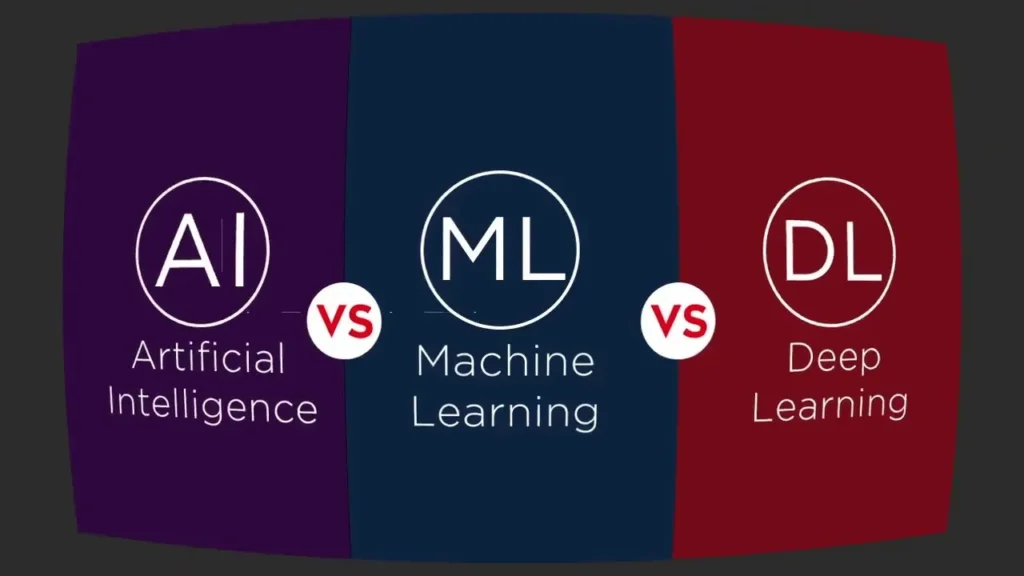
It is easy to get confused by industry jargon. The simplest way to visualize their relationship is as a set of concentric circles: Artificial Intelligence is the outer umbrella, Machine Learning sits inside it, and Deep Learning forms the innermost core.
| Category | Core Definition | Key Characteristic | Typical Example |
| Artificial Intelligence (AI) | Broader concept of creating machines that simulate human intelligence. | Includes both rule-based systems and learning systems. | A chess game program following hardcoded expert rules. |
| Machine Learning (ML) | Subset of AI where systems learn directly from data patterns. | Requires data training rather than manual rule coding. | Email filters catching spam based on word patterns. |
| Deep Learning (DL) | Advanced subfield of ML using multi-layered artificial neural networks. | Processes vast amounts of unstructured data (images, audio). | Autonomous self-driving cars recognizing pedestrians. |
Bottom line: if a system is genuinely learning and improving from data exposure, it’s machine learning, and by extension, it’s also AI. But not every AI system involves learning; some are simply following pre-written logic.
What Are Machine Learning Algorithms? (Types and Examples)
Machine learning algorithms are generally grouped into a few core categories, based on how they learn from data.
Supervised Learning The algorithm learns from labeled data, meaning each example already comes with the “correct answer” attached. A common example is a bank’s fraud detection system: it’s trained on past transactions that are already tagged as “fraud” or “not fraud,” and it learns to spot similar patterns in new transactions.
Unsupervised Learning Here, the data has no labels at all. The algorithm looks for hidden patterns or groupings on its own. A good example is customer segmentation, an e-commerce platform grouping customers into clusters like “bargain hunters” or “premium buyers” based purely on browsing and purchase behavior, without anyone manually defining those categories in advance.
Semi-Supervised Learning A middle-ground approach: a small amount of labeled data is combined with a much larger amount of unlabeled data. This is useful when labeling data is expensive or time-consuming, for example, speech recognition systems that use a handful of manually transcribed audio clips alongside massive amounts of untranscribed audio.
Reinforcement Learning The algorithm learns through trial and error, receiving rewards for good decisions and penalties for bad ones, similar to how a video game character improves by playing repeatedly. This approach is widely used in robotics and self-driving car navigation systems, where the “agent” learns the best sequence of actions over time.
Some of the most widely used machine learning algorithms within these categories include:
- Linear regression: predicts continuous numeric values, like estimating a house’s price based on its size and location.
- Logistic regression: predicts binary outcomes, like whether an email is spam or not.
- Decision trees: make predictions through a series of yes/no questions, similar to a flowchart.
- Random forest: combine multiple decision trees together for more accurate, balanced predictions.
- Neural networks: loosely modeled on the human brain, used for more complex tasks like image recognition and language understanding.
- Clustering algorithms (like K-means): group similar data points together without any predefined labels.
Real-Life Examples of Machine Learning You Already Use
You don’t need to work in tech to interact with machine learning daily, here’s where it’s quietly running in the background:
- UPI and banking fraud alerts: your bank’s system compares your transaction against your usual spending pattern and flags anything unusual in real time.
- Instagram Reels and YouTube recommendations: these platforms study your watch time, likes, and skips to keep refining what shows up next in your feed.
- Google Maps traffic prediction: historical and live traffic data are used to estimate how long your route will actually take.
- Voice assistants (Alexa, Google Assistant): speech recognition models convert your voice into text and predict the most likely intent behind your request.
- Spam filters in your email inbox: trained on millions of past emails to recognize patterns typical of spam, without needing every rule manually written.
What Is Machine Learning Used For? (Real Business Applications)
Beyond consumer apps, machine learning has become a core part of how entire industries operate:
- Healthcare: analyzing medical scans to help detect abnormalities earlier than manual review alone might catch.
- Retail and e-commerce: personalized product recommendations and demand forecasting to avoid overstocking or running out of inventory.
- Finance: real-time fraud detection and credit risk scoring.
- Manufacturing: predictive maintenance, where sensors detect early signs of equipment failure before a breakdown actually happens.
- Marketing: customer segmentation and predicting which leads are most likely to convert.
How Machine Learning Powers Search Engines and AI Overviews
Here’s a part of the conversation that rarely gets covered, but directly affects anyone running a website online: modern search engines and AI-generated answers are themselves powered by machine learning.
When Google decides which page deserves the top spot, or when an AI Overview pulls together a summarized answer instead of just showing ten blue links, machine learning models are working behind the scenes, evaluating relevance, trustworthiness, and how well a page actually answers the user’s question.
This also means the quality and structure of content directly affects whether machine learning-driven systems trust it enough to surface it. Thin, repetitive, or poorly structured content tends to get filtered out, while clear, well-organized, genuinely useful content has a much better chance of being picked up, both in traditional rankings and AI-generated answers. This connects closely to a topic worth understanding in more depth: how data bias in LLMs affects rankings and search visibility, since the same learning systems that improve recommendations can also inherit and amplify bias if trained on skewed data.
Structuring content in a way that machine learning-based ranking systems can actually parse and trust is also central to how AI-driven content actually affects on-page SEO, a factor that matters more each year as search shifts toward AI-summarized answers.
If you’re unsure whether your own website content is structured in a way these systems reward, it’s worth getting it reviewed, agencies like Digimastreys specialize in aligning content with exactly these kinds of ranking and relevance signals.
Benefits and Challenges of Machine Learning
| Benefits | Challenges |
| Automates repetitive, time-consuming tasks | Requires large amounts of quality data |
| Detects patterns humans might miss | Can inherit bias from training data |
| Improves personalization and recommendations | “Black box” models can be hard to explain |
| Enables faster, data-driven decisions | High computational and infrastructure cost |
| Scales easily across huge datasets | Needs ongoing monitoring to avoid model drift |
How to Learn Machine Learning (If You Want to Get Started)
If this topic has sparked curiosity about actually learning machine learning yourself, here’s a realistic, beginner-friendly path:
- Build a foundation in basic statistics and Python. Most machine learning work is done in Python, and concepts like probability, averages, and regression come up constantly.
- Start with the core concepts, not advanced math first. Understand what training data, labels, and predictions mean before diving into complex equations.
- Practice with beginner-friendly libraries. Tools like Scikit-learn let you build simple models (like predicting house prices) without writing an algorithm from scratch.
- Work on small, real datasets. Public datasets on platforms like Kaggle are a great way to practice without needing a company’s private data.
- Move to deep learning once the basics feel solid. Frameworks like TensorFlow or PyTorch come into play once you’re ready for more complex problems like image or text recognition.
It’s a gradual, hands-on process, best learned through consistent practice rather than theory alone.
Bottom Line
Machine learning has transitioned from an experimental branch of computer science into the core engine powering modern software, search engines, and enterprise tools. By shifting from fixed rule sets to adaptive pattern recognition, ML enables computers to tackle complex real-world tasks at scale. Whether you are a business owner structuring content for AI search visibility or a curious learner, understanding these fundamentals is key to navigating an AI-first digital world.
FAQs
What is machine learning? (Machine Learning Definition)
Machine learning is a branch of artificial intelligence where computers learn to spot patterns from past data to make predictions or decisions without being manually programmed for every scenario.
What is machine learning used for?
Machine learning is used for predictive analytics, image recognition, natural language translation, fraud detection in banking, autonomous vehicles, and personalized recommendation systems across streaming and shopping platforms.
How does machine learning work?
It works by collecting data, training an algorithm on that data to find patterns, testing the trained model on new data, and then using it to make predictions on real-world inputs it hasn’t seen before.
What is learning machine?
Learning machine” refers to the same underlying concept as machine learning, a system, usually a computer program, that improves its accuracy over time by studying data rather than relying only on pre-programmed instructions.
How to learn machine learning?
Start with basic statistics and Python programming, understand core concepts like training data and models, practice with beginner-friendly libraries like Scikit-learn on public datasets, and gradually move toward deep learning frameworks as your understanding grows.
Is machine learning AI? (Machine Learning vs AI)
No, machine learning is a specific subset of Artificial Intelligence. AI refers to the broader goal of making smart machines, whereas machine learning is the data-driven method used to achieve that goal.
What are machine learning algorithms?
Machine learning algorithms are the mathematical methods used to find patterns in data during training. Common examples include linear regression, logistic regression, decision trees, random forests, and neural networks.
What are machine learning models?
A machine learning model is the trained result produced after an algorithm has learned from data. While the algorithm is the method used before training, the model is what actually makes predictions once it’s trained and deployed.

Vikas Verma is an SEO specialist and web designer focused on SEO strategy, website design, and digital experiences.