








In modern digital marketing, generic search optimization is no longer enough to win high-intent customers. Whether a user is searching for an emergency plumber or a local digital agency, location context dictates search results.
This is where geo modifiers come in. They bridge the gap between general user intent and hyper-local search discovery, serving as a critical pillar for organic visibility across search engine results pages (SERPs) and AI answer engines.
What Is a Geo Modifier?
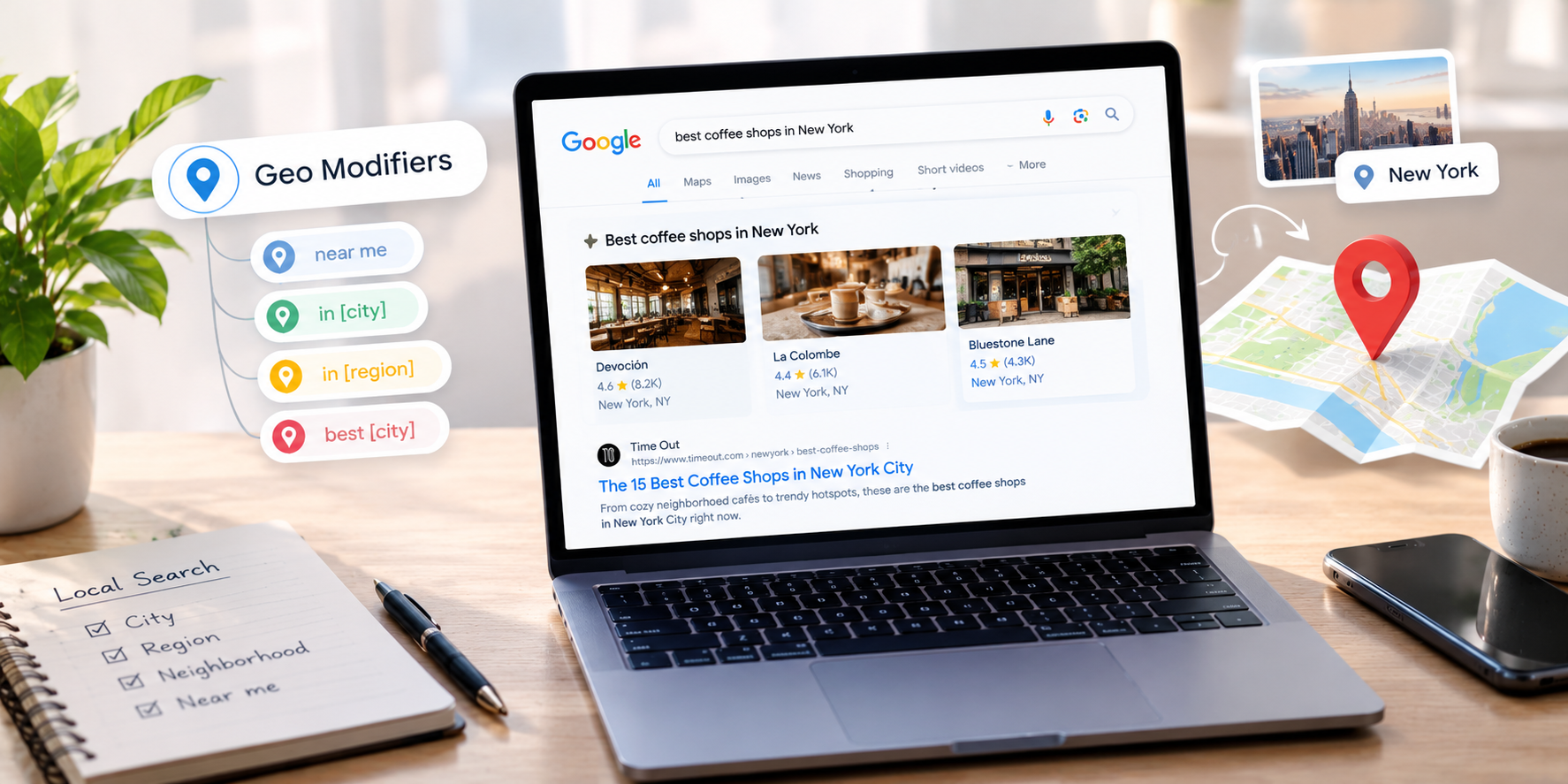
A geo modifier (also known as a location modifier or location-specific keyword) is a geographic phrase added to a primary keyword to target a specific physical area.
Instead of targeting a broad, highly competitive term like "SEO agency", adding a geo modifier transforms the search query into "SEO agency in Chicago" or "local SEO services near me". This explicitly signals to search engines where a business operates and which local audience it serves.
Common Types of Geo Modifiers
Geo modifiers vary by scale and intent depending on how searchers look for nearby solutions:
-
City-Based Modifiers:
"digital marketing agency Austin" -
Neighborhood Modifiers:
"coffee shop SoHo" -
State/Regional Terms:
"electrical contractor Northern California" -
Landmarks & Points of Interest:
"hotels near Times Square" -
ZIP/Postal Codes:
"computer repair 10001" -
Implicit Intent (“Near Me”):
"urgent care near me"(signals local intent using real-time geolocation data)
The 4 Pillars of SEO
Understanding where location signals fit requires looking at the four primary pillars of search engine optimization:
-
1. On-Page SEO: Incorporating geo-modified keywords into page titles, meta descriptions, $H_1$/$H_2$ subheadings, and body content naturally embeds location signals into web pages.
-
2. Local SEO: Optimizing Google Business Profiles (GBP), local citations, Name-Address-Phone (NAP) consistency, and geotagged content. This is where geo modifiers deliver their highest ROI.
-
3. Content Strategy: Developing location-specific guides, landing pages, and FAQs that answer geo-targeted customer questions.
-
4. Technical SEO: Ensuring site structure, schema markup, Core Web Vitals, and crawlability support seamless local content indexing.
Pro Tip: Aligning local structured data with location-specific pages helps search engines parse regional service boundaries. Ensure your site adheres to a clean Technical SEO Checklist and optimized On-Page AI SEO principles.
How Geo Modifiers Drive Geomarketing
Geomarketing is the practice of leveraging location data to deliver targeted marketing experiences. Geo modifiers represent the search engine execution of this strategy.
When businesses evaluate customer demographic data, they often discover hyper-local search habits. For instance, a legal firm in Nashville might realize potential clients search for "family lawyer Green Hills" far more frequently than general city-level terms. Tailoring page content to these specific neighborhoods drives higher-converting, low-competition organic traffic.
Local Search Strategy Comparison
| Optimization Model | Core Focus | Primary Signal | Main Benefit |
| Broad Keyword Targeting | High search volume | Global/National relevance | Broad reach, high competition |
| Geo-Modified Targeting | Specific geographic intent | Location modifiers ($City$, $ZIP$, $Landmark$) | High conversion rate, lower competition |
| Hyper-Local Geomarketing | Neighborhood & proximity intent | Geofencing & neighborhood signals | High-intent foot traffic & local leads |
To see how modern search systems process location intent across generative features, read our guide on How AI Mode Impacts Local SEO and explore our complete framework for Local SEO & AI Search Strategies.
Frequently Asked Questions
What is the difference between a location modifier and a geotag?
A location modifier is a text keyword added to search queries (e.g., "plumber Miami"). A geotag refers to technical metadata embedded inside media files or code (such as GPS coordinates attached to images or schema markup).
Why are geo modifiers vital for Answer Engine Optimization (AEO)?
Voice assistants and conversational AI search engines prioritize high-proximity, direct answers. Small businesses must incorporate geo-modified phrasing to capture conversational queries like "who is the best electrician near me". Learn more about this shift in our guide on Why Small Businesses Must Focus on AEO.
Are geotargeting strategies compliant with privacy regulations?
Yes. Keyword-based geotargeting relies entirely on public search queries rather than tracking private personal data. However, campaigns that collect or process precise user location data must comply with local privacy regulations and FTC guidelines.

SURBHI THAPA
Surbhi Thapa is an SEO specialist focused on SEO strategy and content optimization.
Surbhi Thapa is an SEO specialist focused on SEO strategy and content optimization.